
The legacy of Viktor Frankl’s books and psychological theory is an important testament to the value of discerning the nature of man as not only physical, and psychological, but also spiritual.
Wikipedia’s summary is that “Viktor Frankl (1905 – 1997) was an Austrian neurologist, psychologist, philosopher, and Holocaust survivor, who founded logotherapy, a school of psychotherapy that describes a search for a life’s meaning as the central human motivational force … Frankl published 39 books. The autobiographical Man’s Search for Meaning, a best-selling book, is based on his experiences in various Nazi concentration camps.”[1]
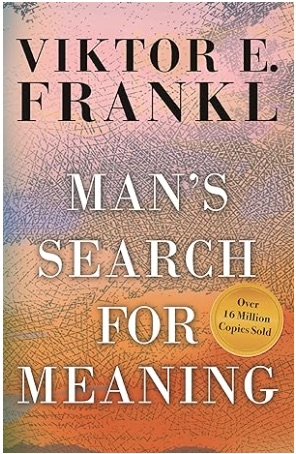
Man’s Search For Meaning is an important book, having sold over 16 million copies. The publisher gives this description: “Viktor Frankl’s riveting account of his time in the Nazi concentration camps, and his insightful exploration of the human will to find meaning in spite of the worst adversity, has offered solace and guidance to generations of readers since it was first published in 1946. At the heart of Frankl’s theory of logotherapy (from the Greek word for ‘meaning’) is a conviction that the primary human drive is not pleasure, as Freud maintained, but rather the discovery and pursuit of what the individual finds “meaningful.”[2]
Frankl’s observations, derived from his spiritual capacities, considers man as a three dimensional being, who searches for meaning, has a conscience, and is capable of self-transcendence. [Even if a person is not spiritually alive toward God, he can perceive basic spiritual realities.] As the apostle Paul declared about humanity, “because what may be known of God is manifest in them, for God has shown it to them. For since the creation of the world His invisible attributes are clearly seen, being understood by the things that are made, even His eternal power and Godhead…” (Rom. 1:19,20). Romans 2:15 adds that everyone has a conscience, which is a faculty of the spirit of man (Rom. 2:15).
Hendrika Vande Kemp made this observation about Frankl’s recognition of the psychological / spiritual distinction in man:
“…Many contemporary depth psychologists … are forced to confront the unconscious in all its complexity and, through their clinical experience, find that it manifests itself in two forms which are at times distinct, at other times indistinguishable: spirit and soul. Such a version of trichotomy may be found in Frankl, who divided individual functioning into three factors: physical, psychological, and spiritual (Tweedie, 1961). Here, we are spiritual beings who have a psyche. Consciousness grows out of unconscious spirituality, which also gives rise to love, conscience, and esthetic appreciation. The spirit may be masked by the psyche, in that neuroses and psychoses interfere with the free expression of spirituality.” [3]
We can conclude that it is the spiritual dimension of man that lifts one to be aware of these life principles, including the search for meaning. The basic principles that Frankl articulated can be deduced from general revelation—personal consciousness and life experience. These tenets helped him, and have helped others, navigate the sorrows of life in this fallen world.
________________
[1] https://en.wikipedia.org/wiki/Viktor_Frankl
[2] https://www.viktorfranklinstitute.org/about-logotherapy/
[3] Hendrika Vande Kemp, “The Tension Between Psychology and Theology: An Anthropological Solution.” Journal of Psychology and Theology, 1982, Vol. 10, No. 3, 208-09.
J.B.W.
 Biblical Psychology