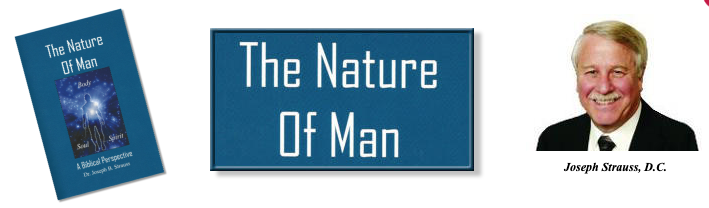
Years ago I attended a conference for The Christian Chiropractors Association in North Carolina. (A personal friend was their speaker and invited me.). There I noticed a book by Dr. Joseph B. Strauss titled The Nature of Man: A Biblical Perspective.[1] Since this is a special area of interest for me, I bought a copy.
About Joseph Strauss
Dr. Joseph B. Strauss (1945–2023) was an American chiropractor, Christian writer, educator, and influential thinker in the philosophy of chiropractic. He was particularly known for his extensive writings on chiropractic philosophy and his efforts to understand the relationship between biblical Christianity and the philosophy of human life.
The Author’s Professional credentials:
- Doctor of Chiropractic: Graduated from the Columbia Institute of Chiropractic (now New York Chiropractic College) in 1967.
- Clinical practice: Established a private chiropractic practice in Levittown, Pennsylvania [where my wife grew up!], where he served patients for more than 45 years, retiring in 2013 [treating tens of thousands].
- Educator: Taught chiropractic philosophy at Pennsylvania College of Straight Chiropractic from 1978 to 1994 and served as the college’s president in 1980–1981. [2]
The Author’s Commitment to Biblical Studies
The author confides,
“I have been a student of the Bible for over 50 years. I have had university education in theology and have sat under a number of the greatest Bible teachers of the last half of the 20th century … I have a deep reverence for God and His Word.” (p. 12).
Book description
The CCA bookstore gives this description of The Nature of Man: A Biblical Perspective:
“How do the body, soul, and spirit inter-relate? How does each affect the other? Why do science and theology appear to be at odds? Why is there so much disagreement among theologians? Dr. Strauss has written a clear, easily understood text for both the lay person and the serious student of the Word in order to shed light on these questions. His answers to issues that divide the Christian community and confuse the scientific community will bring new understanding to the reader.”[3]
The author has done a thorough job of studying the subject of biblical anthropology/psychology in these 293 pages. He searches the Scriptures and consults original language lexicons and theologians. As a chiropractor, he has a particular purpose in gaining a clear understanding of how God designed us to live with vibrant health. Although his views are informed by studies in human anatomy and physiology, he acknowledges the teaching of the Holy Bible as the primary basis for the book (p. 13).
The Book’s Table of Contents
- Part 1 – The Body (chs 1-10)
- Part 2 – The Soul (chs 11-17)
- Part 3 – Spirit
- Part 4 – The Application of the Nature of Man to Society
- Part 5 – The Application of Doctrine in the Life of the Believer
- Closing Thoughts
The book’s case for man as spirit, soul, and body
Here are some excerpts of his presentation of the trichotomous makeup of man:
“I am convinced, after much study, that man was created, and designed to be trichotomous, that is, having a body, soul, and spirit. I am well aware that there are theologians who may disagree with me on the subject. Some scholars do not make a differentiation between soul and spirit… I am convinced that Adam was created trichotomous, possessing a body, soul, and spirit.” (p. 32)
Strauss affirms that man is more than dichotomous: “We must acknowledge that man has more than just material and immaterial because we know that man is more than any plant in the plant kingdom or any animal in the animal Kingdom, both having material and immaterial components.” (p. 211). For man to not be only different but superior to the plant or Animal Kingdom, he must have and be something more. That’s something, in my opinion, is his trichotomous nature…” (p. 212)
“Bible scholars generally agree that the soul has self-consciousness self-awareness, will, mentality, and memory … The body is the material part of man…” (p. 33 ). “Along with the intellect and will, we usually classify emotions as a third aspect of the soul” (p. 176). “Soul and spirit are described by the words psuche and pneuma, respectively. Spirit then is the third part of man’s trichotomous nature … The human spirit is that part of the human organism, that immaterial part, which is able to have fellowship with God. It is our spirit which communicates with the Father through the Holy Spirit” (p. 35). “The fact that the soul and the spirit have some similarities does not make them the same … Both address relationships: the soul enables us to relate to people, the human spirit enables us to relate to God.” (p. 213).
The author’s has a holistic emphasis: “Our emphasis is upon the interaction of body, soul, and spirit and their interdependence and proper functioning within a human being. In order for the soul to be expressed and to function optimally, the material of the body must be adequately taken care of and maintained in a healthy state. We all have a responsibility to care for the body.“ (p. 201)
Strauss quotes the explicit spirit, soul, and body texts of 1 Thessalonians 5:23 and Hebrews 4:12, and examines other verses’ use of spiritual and soulical.
The author notes original sin’s impact on man’s spirit: “Adam and Eve died spiritually the moment they disobeyed God. Spiritual death eventually leads to human death (separation of the soul from the body) which is co-terminous with biological death of the person” (p. 43).
He includes the nature of regeneration at salvation and quotes 2 Corinthians 5:17 – “If anyone is Christ he is a new creation. Old things have passed away; behold, all things have become new.” “We have the same body the moment after we accept Jesus Christ as our personal Savior. We have the same soul in that instant. In time, there may be changes in norms and standards of our soul, exhibiting a more divine viewpoint of life…As believers we are set apart, sanctified, and different, and our new creatureness is that of aquiring a [new] human spirit in addition to the indwelling Holy Spirit” (220).
Critique
Although consistently teaching the distinction between soul and spirit, including how the spirit was the locus of death in the Fall and in regeneration at salvation, Strauss believed that the unregenerate human being does not have a human spirit. He defines the new birth— regeneration—as the creating of a human spirit in the believer: “As previously explained, after Adam, every person ever born has been born spiritually dead, with no human spirit. That spirit is created and placed within us at the moment of salvation by God, the Holy Spirit” (p. 226). Thus, Strauss concludes that the unsaved/unregenerated person only has a body and soul, not a human spirit. “Only those people who have a relationship with God through Christ possess this third aspect of man, a human spirit” (p. 212; cf. pp. 45, 200, 213, 215, 216, 219).
However—to my knowledge—most Bible-believing Christian trichotomists affirm that all people are body, soul, and spirit, whether saved or unsaved.
Trichotomists also assign the faculties of intuition and conscience to the human spirit.[4] (These faculties raise humans above the capability of animals which are not made in God’s image.)
- Although spiritually dead toward God, unregenerate people still have enough spiritual intuition to know that God does exist. To disbelieve is to “suppress the truth” (Rom. 1:18-20).
- Likewise, unregenerate people have the inner witness of conscience to which they are accountable (Rom. 2:15).
The triune nature of man is a feature of being created in God’s image (Gen. 1:26). God’s declaration of capital punishment for a murderer is based on the human victim having God’s image (Gen. 9:6). This law is not limited to forbidding the murder of people with a regenerated human spirit.
So we define spiritual death of fallen man as being dead toward God, separated from His life. This separation was further illustrated by banishing Adam’s and Eve from the Tree of Life in Eden (Gen 3:2-24 )
Interestingly, Dr Strauss makes a case for “separation” of Adam’s spirit related to the Fall (Gen. 3), but considers it as a separating the human spirit from the body, resulting in the human spirit’s non-existence. “Spiritual death for Adam and Eve was separation of their human spirits from their bodies” (p. 226).
Accepting his correct definition of “death” in the context of spiritual death at the Fall, the usual view (which I hold) interprets spiritual death as separation from the life of God. Therefore, unregenerate people have a human spirit, but it is dead toward God, separated from His life. They are unable to discern biblical truth (1 Cor. 2:14). But at regeneration (Titus 3:5-7), the human spirit is born again, united to God’s Spirit (Cor 6:17), becoming a new creation spiritually (2 Cor. 5:17).
Consider this illustration in support of the usual trichotomist view: “The spirit of a man is the lamp of the LORD, Searching all the inner depths of his heart” (Prov. 20:27 NKJV). If an oil lamp is envisioned here, at the Fall, the flame was extinguished; man’s spiritual light went out. However the “lamp” is still present, although not functioning according to its purpose.
In his book, The Mystery of Godliness, Ian Thomas gives a detailed description of man as spirit, soul, and body and related the implications to creation, the Fall, regeneration, sanctification and glorification. Note how he explained how unregenerate man still possesses a human spirit.
“Therefore, just as through one man sin entered the world, and death through sin, and thus death spread to all men, because all sinned” (Rom. 5:12). “What happened? God had said, for in the day that thou eatest thereof thou shall surely die“ (Genesis 2:17). Did Adam die in the day that he ate thereof? Not physically!… Physically alive and soulishly active, the animal part of him survived, but the very day that he repudiated his dependence on God, Adam forfeited the presence of God! … God had thrown the master switch, and the Holy Spirit withdrew from the human spirit, and the life went out [Eph. 2:1], the light went out [Prov. 20:27], and the soul of man was plunged into the abysmal darkness of a fallen humanity [Rom. 1:21]… Godlessness, lifelessness, and lightessness were the inevitable consequences of Adam’s [negative] conversion [to the kingdom of darkness Col 1:13]! …
“It is important to point out at this stage, that even in his unregenerate, fallen condition, man is still not just a mere animal. For there is still within him–though empty of God and spiritually dead–the human spirit. This, added to his soul, (as the marrow to the joints [Heb.4:12]), not only enables man, though unredeemed, to survive physical death and remain morally responsible to God, but before physical death, makes it possible for a man to be spiritually regenerate by faith in Christ, no matter how degenerate he may have become.”[5]
Thankfully, Strauss had a non-dogmatic attitude that was open to clarifications such as the one just presented: “While the Word of God is infallible, I am not! I realize that presenting so much new information raises the clear possibility that I have misrepresented some point or points of doctrine…Thankfully, we have the Holy Spirit of God as a filter for all information and I pray He will be active in your heart and mine as we meditate upon the contents of this book” (p. 293).
I suppose that if Dr. Strauss had read The Mystery of Godliness, he would have had a different view of the condition of unregenerate man.
Conclusion
This article is not a full book report of Strass’s study of the nature of man. This is a very substantial volume that is not only biblical and theological, but practical in its purpose to educate health practitioners. It is worth reading, contemplating and applying.
JBW
______________
1 Joseph Strauss, DC, The Nature of Man: A Biblical Perspective (Joseph Strauss, 2010).
2 https://www.sherman.edu/strauss/
3 https://www.christianchiropractors.org/mem_svs/books2.htm
4. For example, The Spiritual Man, by Watchman Nee, parts 1,4.
5 W, Ian Thomas, The Mystery of Godliness (Zondervan, 1964) 80-82.

