Reverend Doctor George Campbell Morgan D.D. (1863–1945) was a British evangelist, preacher, a leading Bible teacher, and a prolific author…He was the pastor of Westminster Chapel in London from 1904 to 1919, pausing for 14 years to teach at Biola in Los Angeles, and returning to the Chapel from 1933 to 1943 when he handed over the pastorate to the renowned Martyn Lloyd-Jones, after having shared it with him and mentored him since 1939. From 1911 to 1914 he was the president of Cheshunt College, Cambridge.”[1]
Ministry (an International Journal for Pastors) published an article with this commendation: “Campbell Morgan … was eventually acclaimed ‘the most outstanding preacher this country (the United States) has heard.’ Between 1886 and his Diamond Jubilee, he preached some 23,390 times and wrote over seventy books. He was an ideal husband and father, whose four sons followed him into the ministry (what higher tribute could be paid to a preacher?). No breath of scandal ever touched his life.[2]
In his book, Life Problems, chapter one addresses the topic of “Self.” After considering the dignity of man through an exposition of Psalm 8, Morgan turned to the New Testament to examine man’s makeup. His explanation of the tripartite makeup of man is quite detailed and is worth quoting here in full.
Now I propose finding my definition [of the nature of man] in the New Testament, and I shall only trouble you to look at it in order to remember the phrase. In Paul’s first letter to the Thessalonians, in the last chapter and the 23d verse, he makes use of a phrase of infinite meaning, as I believe, giving us in his own clear, lucid way a definition which answers the question propounded in this psalm of olden times — “The God of peace sanctify you wholly “; and then he proceeds to give us an exposition of his own phrase “wholly.” What does he mean when he says that sanctification has to be wholly complete? “May your spirit, soul, and body be preserved entire, with-out blame, unto the coming of our Lord Jesus Christ.” I am not discussing this text; I am simply lifting out of it— in order that we may study the problem that faces us — that one phrase, “your spirit, soul, and body.” And upon this occasion the original words are used most carefully; and that is why I take this phrase and ask you to look at it for a moment or two. Spirit, soul, and body. That is man. Shall we take each of these and consider them briefly, only for the purpose of our argument; and that we may follow the line of thought we shall not take them in the apostle’s order, but we shall, reversing the order, take first body, then soul, and then spirit.
Body. “What is man?” We have too long answered the question carelessly, and have said body and soul, and too long been misusing a word by talking about saving the soul. Now what a man needs to have saved in that evangelical sense of the word, is not the soul, but the spirit. Let the spirit be regenerated, and then soul and body alike are saved; but it is important that we should look at this vision and consider these words — body, soul, and spirit. The body is of the earth, and therefore earthy, and yet it is the highest form of earth-life. Let us be very simple and childlike as we think about that lowest form of human personality — physical power. It was the psalmist who said we are ”fearfully and wonderfully made,” and yet how few of us realize that that is true; how few have set themselves, quietly and thoughtfully, to think of the marvellous and matchless mechanism of their own frames! This is the day of invention and of progress, when man is engaged in a continuous whirl of discovery; and according to the very latest book by Mr. Bellamy, ”Equality,” the time is coming when we shall not work, but press a button and everything will be done for us. May I be dead before the day comes! That is all I wish. But we are discovering everywhere, and men are perpetually inventing new forms of machinery. But the mechanism of my hand has never been equalized in the dream of any inventor; and what is true of me is true of every one. Take the hand, and you will find that the thumb faces every finger so that I can pick from the ground the smallest thing that my hand can lift, and also grasp the lever that moves great masses of matter. You remember when you had those first visions of physiology that so en- tranced some of you that you never left the study, and finally mastered it, and entered upon a profession that has served humanity and is always an adornment. Some saw the vision and were afraid, and drew back. Think of it for a moment, the body of man, and remember there is no flower that blossoms upon the sod so fair; no tree that grows in the wood so wondrous in its powers of endurance. “Oh,” but you say, “there are trees growing to-day that were old when we began to be”; but they have never faced such storms as you have. All the wind that blows, the rain that splashes, and the changes of atmosphere that tell upon the oak, are child’s play compared to the mental anguish and heart-break that have swept across your life; and yet you have endured. With God a thousand years are as a day; and with man, as compared to the oak, a thousand years are as a day. One day has in it of force and meaning more than all the life the plant or the tree lives in its long succession of the seasons. So if you think of the material side of man’s existence, he is more wonderful in his strength, as in his beauty, than anything else God has made. And yet what is this frame of mine ? It is the carbon upon which the light of God is to play and have its work. As is the carbon to the electric light, so is the body of man to the spirit of man. Only that, nothing more! It is the basis of life, that upon which the rest manifests itself for the time being, and only for the time being. This body of mine, surpassing in its wonder all human understanding, is for to-day, not to-morrow. In God’s great to-morrow, I must have a body of another form — no longer the earthly and material, but the heavenly and the spiritual. This is the tabernacle for the spirit in the day of its probation. More marvellous in its mechanism, as we have said, than sun, stars, tree, or plant, or any other form of matter; and yet being but the lowest stratum in the complex life of man.
Soul. — This word “soul” — the Greek word — is a word that always refers to the animal life of man, the conscious force, that within which feels pain or joy. You will agree that the animal life in man far exceeds, in every way, all other forms of animal life. Remember that man, as an animal, without any reference to the great crowning glory, is capable of art, and music, and literature, and imagination. All these things may flourish even though a man be spiritually dead. I want to save that phrase now, because it is on your mind. I may forget to correct it. Some one says, “Do you mean to say that these may all find full play in an unspiritual man? ” By no means. I say the best art the world has ever known has been inspired, and under the dominion of spirit. The finest poetry that men have ever penned has been written when the life was under the dominion of the highest form of its complex nature — spirit. But this I do say, within the mental range of the soul life there may be art, music, literature, and imagination, all the while the spirit of man is dead in trespasses and sins. This is no new story or theory. If you trace your way back to Genesis you will find how Enoch was the seventh from Adam through Seth; and of Enoch it was said, “he walked with God.” Lamech lived about the same time, he being the seventh from Adam through Cain; and you study his times and find how there was industry, and art, and the enfranchisement of woman — all without God. And that old story has been repeated ever since. A man can be an artist, a poet, a literary genius, a messenger to his fellow-men on high moral lines, even though the spirit is dead. But, so far, we have only touched upon the body and soul. What next?
Spirit. — That which is divine; the free breath of God. Divine in its possibilities and powers, the supreme glory of every human life, unheard of by any form of lower life than man — the spirit. If I meet a man in the road, I meet first of all his bodily presence. That appeals to me through the avenue of my sight. But when presently we pause and hold converse, I reach his soul — the mental side of the man — through the avenue of his speech; but when I have lived with him and tabernacled with him, I shall reach, if it be alive and prospering there, his spirit, not through the avenue of sight or speech, but through the avenue of the influence he will exert upon me. Thus the easiest thing which I can come in contact with is his body, the physical side of his nature, fearful, wonderful, majestic. More difficult to realize is brotherhood in the region of the mind; but most subtle and hard to reach is the kindred touch of spirit that is the crowning glory of every human being. What is man? Less than the heavens, and yet so wondrous in himself that God is mindful of him and visits him. Man is body — of the earth ; he is soul — the highest form of animal life; he is spirit— offspring of God, created not only by Him, but in His image.
“What is man?” He is the union of the spiritual and the material. He is the crown of all nature, and in man nature blossoms into God. You may have your evolutionary theory at this point, if you like; you may take your lowest form of life back to what scientists speak of as protoplasm. Ruskin said it would spoil a good deal of the scientific aspect of things if the words of the teachers were explained. Protoplasm means, “first stuck together.” It may be well to remember that. Go back to them, because I should like to know what was stuck together, and who stuck them. But get back to your “first stuck together,” and watch it upward, if you like. I am not going to quarrel with it. I don’t know enough to say whether it is true; but whether it is true or not, one thing is certain, that behind all is God. Let me travel up through every point of beauty, growing grander and grander until it is lost in man, and in man all nature touches God. For in man there is the Divine spark, the Divine nature; and every man, woman, and child is a part of God, created in His image, and touched with His life and spirit. Nature touches God nowhere but in man, in that sense there is nothing of the Divine on the earth save man; and in the heaven that lies above us and the light that is beyond the shadow, there is nothing, so far as we know, of earth but man. So man becomes the strangest and grandest of the works of God, in his own being marrying earth and heaven, linking matter to spirit, and being in himself at once of the earth and of the heavens — the strangest and most marvellous combination of the skill and work of the Divine.
If man sin, then all nature will go down with him, trees, and flowers — on all will be the chill of man’s sin. Well does the writer of the New Testament say that ‘*the whole creation groaneth and travaileth together in pain until now” [Rom. 8:22]. Then, when spirit is dominant in man, he is at his best. Spirit is supreme; and soul and body are subservient to spirit. And when spirit is supreme, man has dominion, as the psalmist says, and the writer of the Hebrews repeats ”over all things.”
Then if man be spirit in his complex and essential being, he is immortal, and there is no death. “Oh,” you say, “but there is death. Men have died through all the ages.” My friends, that is not a part of our study. ”What is man?” I do not ask what he is in his fall. Remember, ‘the wages of sin is death.’ Death came in because of sin in man himself; in the essential glory of the Divine creation there is no death, transition rather. This life is a probation, a time of testing and trial, in which all the magnificence of his own being comes before his own vision. Then, when the testing time is over, and the work is done, comes the change — the transition, that leaves behind the process of probation, and takes up new work in the Kingdom of the Eternal, fulfilling the purpose of God, and stepping out to unknown regions of which man in all his dreams can say nothing, for God has hidden these things. “What is man?” Body, soul, and spirit. [3]
Since G.. Campbell Morgan earned great respect as a Bible Expositor, preacher and author, we implore those who are dogmatic in their views of dichotomy to acknowledge that holistic trichotomy be recognized as a legitimate, reasonable interpretation of relevant Scriptures and within in the scope of doctrinal orthodoxy.
J.B.W.
[1] https://en.wikipedia.org/wiki/G._Campbell_Morgan
A previous post documented Morgan teaching on this theme in his book, Christian Principles.
[2] https://www.ministrymagazine.org/archive/2000/05/man-of-the-word-the-ministry-of-g.-campbell-morgan
[3] Rev. G. CAMPBELL MORGAN, Life Problems New York, Chicago, Toronto: Fleming H. Revell Company, 1899, pp. 18-29.
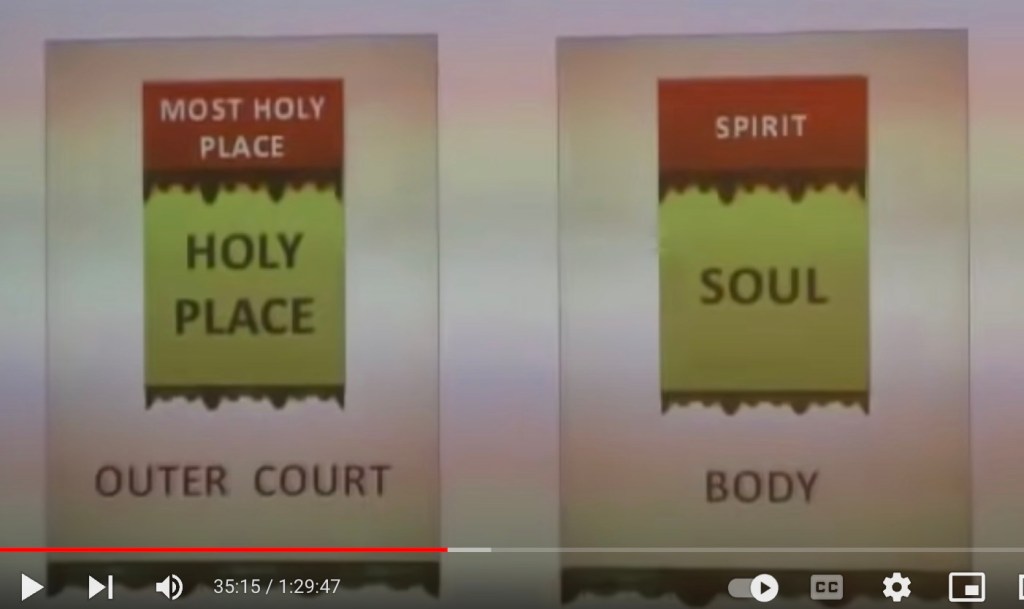
 In this teaching message, Zac Poonen refers to 1 Thessalonians 5:23 and Hebrews 4:12 to describe man as spirit, soul and body (minute 21:00).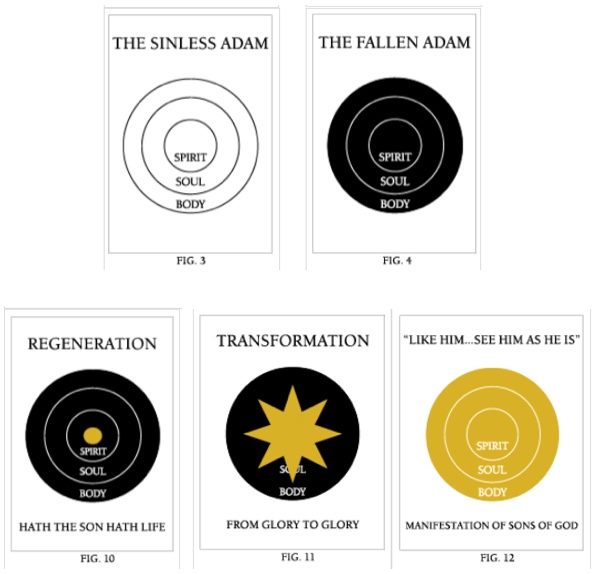
 “Clive Staples Lewis (1898–1963) was one of the intellectual giants of the twentieth century and arguably one of the most influential writers of his day. He was a Fellow and Tutor in English Literature at Oxford University until 1954, when he was unanimously elected to the Chair of Medieval and Renaissance Literature at Cambridge University, a position he held until his retirement. Lewis wrote more than thirty books, allowing him to reach a vast audience, and his works continue to attract thousands of new readers every year. C. S. Lewis’s most distinguished and popular accomplishments include Mere Christianity, Out of the Silent Planet, The Great Divorce, The Screwtape Letters, and the universally acknowledged classics in The Chronicles of Narnia. To date, the Narnia books have sold over 100 million copies and been transformed into three major motion pictures.”[1]
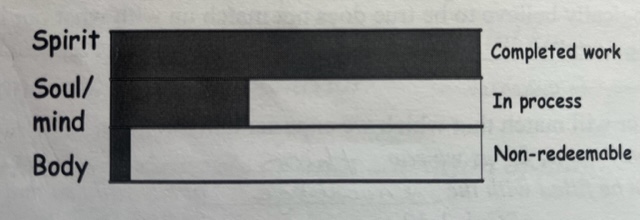
 A. J.”Gordon (1836–1895) was an American Baptist preacher, writer, composer, and founder of Gordon College and Gordon–Conwell Theological Seminary. In his book In Christ: The Believer’s Union with His Lord, he described the whole nature of man as spirit, soul, and body.
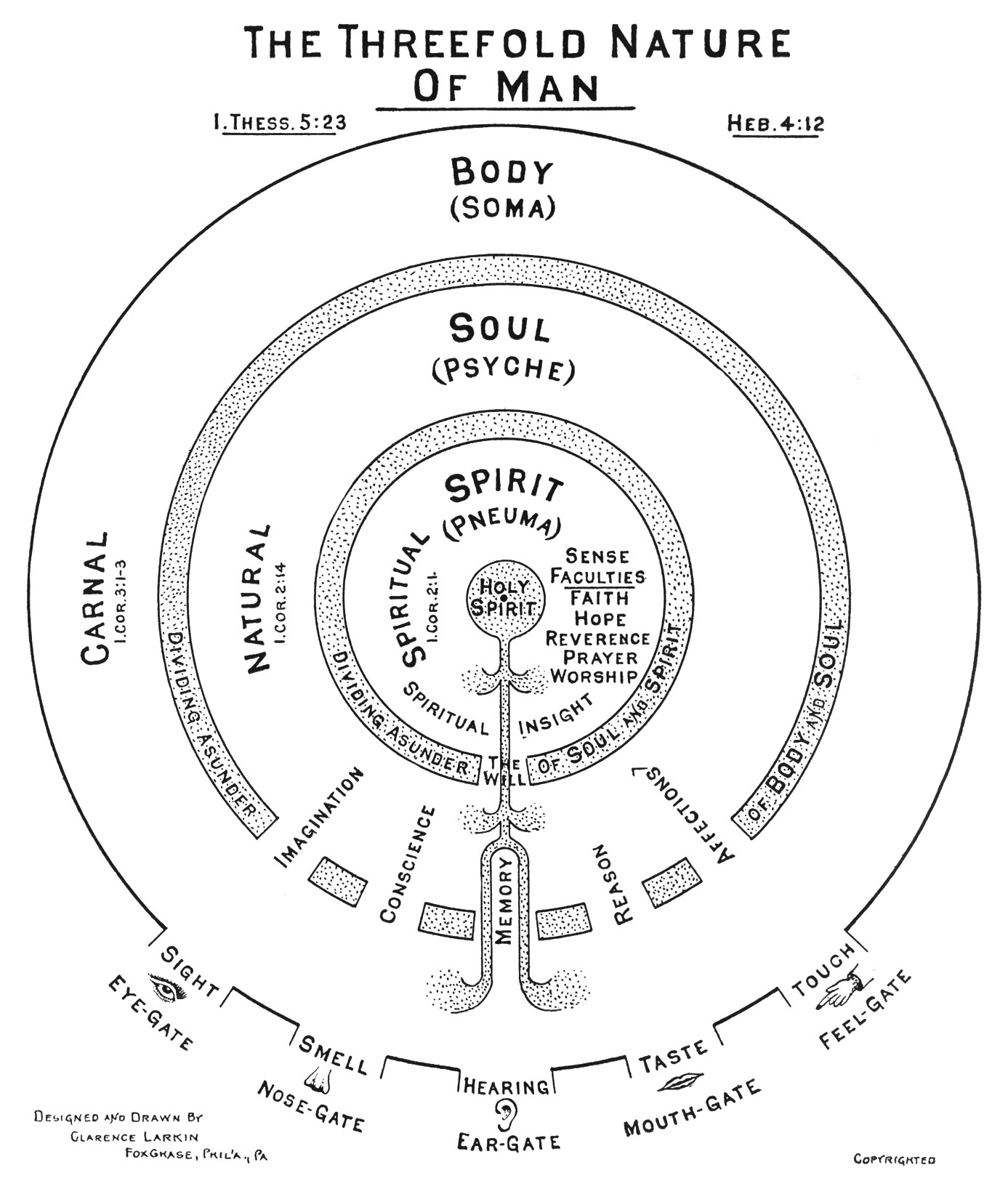 [
For more on pastor Larkin, see
[
For more on pastor Larkin, see