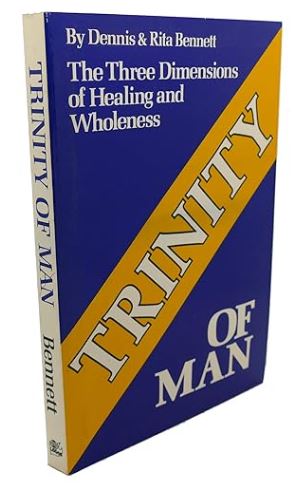
The Trinity of Man

The Trinity of Man was published in 1979 by Logos International (now Bridge Logos). It is rare for a full length book on this topic to be published by a trade publisher. Additional distinctive features of this volume include:

  • It was written by a prominent husband and wife team, Dennis and Rita Bennett, who published other books (separately and together).
  • The first quarter of the book is written in a novel style, introducing the issues of salvation, discipleship, and the model of man.
  • In the remaining chapters, the book covers the scope of redemption history and how it relates to man as spirit, soul, and body: creation, the fall, regeneration, and sanctification.
  • This volume is not theoretical, by applied pastoral theology. The orientaion is to engae the reader at a popular level and relate the clarified model of man to discipleship, counseling, and soul healing.
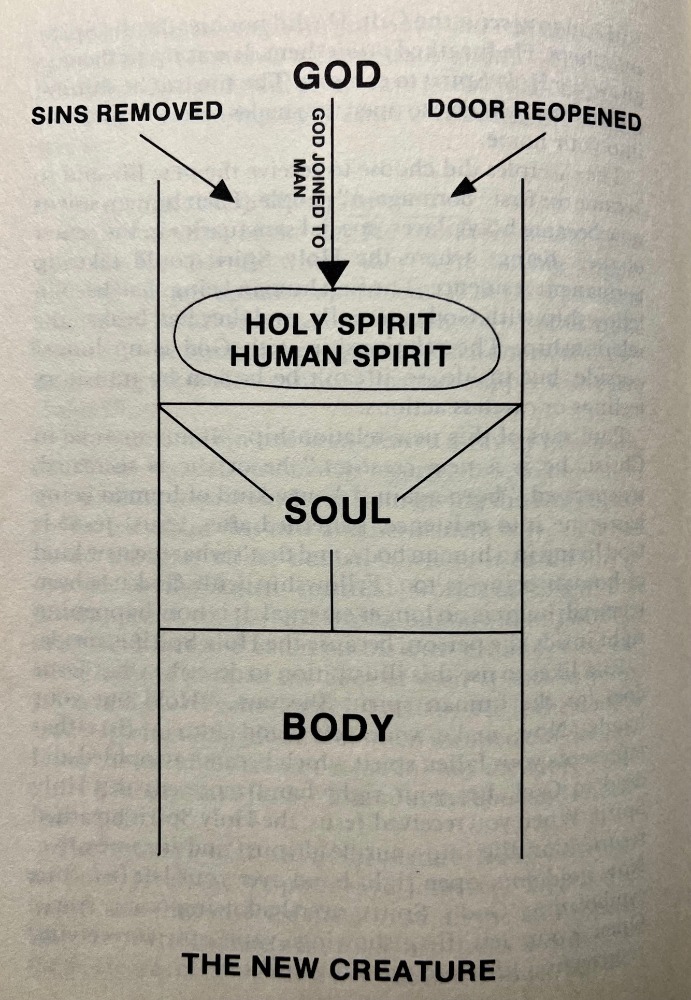
  • Several diagrams are used in the book to illustrate various aspects of biblical anthropology as it relates to unfolding topics addressed.

Since the terms soul and spirit are sometimes used interchangeably, the authors recommend that the reader consult a Greek concordance to do their own New Testament word study. Today that is much easier task using Bible research tools such as BlueLetterBible.org (interlinear tools).

When discussing the topic of spiritual warfare, the authors correctly discern that the human spirit is sealed by the Holy Spirit (Eph. 1:13; 4:30) and secure from demonic attachment. However, the warnings of Ephesians 6:10-18 are very relevant concerning the Enemy’s potential oppression of the believer’s soul and body (chapter 22).


Note about the author’s charismatic orientation

Dennis J. Bennett (1917 – 1991) was an American Episcopal priest. He was born in England but raised in California. Bennett was a seminal figure in the Charismatic Movement within the Christian church.[1] Since 2010 The library of Regent University (Virginia) hosts the collection of these authors.

“In 1966 he [Dennis] married Rita Reed, and soon after, they co-founded the Christian Renewal Association, taught numerous workshops and retreats together, and, eventually, co-authored five books. In 1981, Rev. Bennett was designated a Canon of Honor of the Diocese of Olympia in recognition of his work in the charismatic movement. That same year, he resigned as rector of St. Luke’s to write and conduct seminars and conferences. With his wife Rita, he ministered in evangelism, healing, and church renewal throughout the U.S. and the world. In 2012 he was posthumously awarded an Honorary Doctor of Divinity by Oral Roberts University.”[2]


Although BiblicalPsychology.net does not teach from a Pentecostal/charismatic interpretation of the Baptism of the Holy Spirit and the expected use of speaking in tongues, nevertheless, this book covers the topic of the trinity of man effectively and practically. Readers with a charismatic/Pentecostal view and experience would be even more appreciative of this volume.

JBW


[1] Larsen, Timothy; Bebbington, David; Noll, Mark A. (2015). Biographical Dictionary of Evangelicals. Inter-Varsity Press. p. 45. cf Encyclopedia Britannica

[2] https://libguides.regent.edu/djbennett

The Use or Misuse of the Trichotomy of Man

One of the objections to the spirit, soul, and body view of man by some biblical counselors is that it can be used to promote psychiatry and psychotherapy and diminish spiritually oriented counseling.

Admittedly, we see an obvious connection of the aspects of man’s makeup with three general approaches to therapy:

  • Body: The psychiatrist has a physical orientation. He/she is an M.D. with advanced training in psychopharmacology and related matters. Their primary modality is to treat disruptive mental and emotional problems with prescribed medication.
  • Soul: The psychotherapist (such as a licensed professional counselor) will have a soul treatment orientation. Even the name conveys this (a combination of the Greek words for soul + treatment).
  • Spirit: The pastoral/biblical counselor has a special concern for spiritual realities (such as regeneration and sanctification). Since secular psychiatry and psychotherapy usually ignore or misinterpret the root cause(s) of mental, emotional and behavioral problems, the pastoral counselor brings biblical revelation to bear on resolving personal and relational conflicts. Sin requires forgiveness, and self-centeredness needs to be replaced with Christ-centeredness (1 John 1:9; Romans 12:1,2; Gal. 2:20).

Since we are advocating holistic trichotomy, we hasten to add that the pastoral counselor should be informed and sensitive to any physical factors and psychological and relational issues that pertain to the therapeutic goals of counseling.

Although spirit, soul, and body are ontologically distinct, they are interrelated in influence and functioning. We need to care for and treat the whole person and his/her relationships.
   
Some Christian integrationist counselors have used the spirit, soul, body distinction to minimize or marginalize biblical counseling. They claim the soul or physical domain as their specialties, bolstered by the status of licensure and —in some districts —preventing non state-licensed helpers from using the title of “counselor.”

Now to the main point of this article: Does the potential misuse of the spirit, soul, and body view of man justify rejecting the doctrine of man as trichotomous? This seems to be the case behind an unnecessary dogmatism in favor dichotomy in some biblical counseling organizations.

          
Answer: If the potential misuse of a doctrine prevents it being received, believed, and taught, other evangelical doctrines would be abandoned.

Examples.

1.The doctrine of the Second Coming of Christ is an important, practical, biblical teaching. For example, 1 Thessalonians 4:15-18:

For this we say to you by the word of the Lord, that we who are alive and remain until the coming of the Lord will by no means precede those who are asleep. For the Lord Himself will descend from heaven with a shout, with the voice of an archangel, and with the trumpet of God. And the dead in Christ will rise first. Then we who are alive and remain shall be caught up together with them in the clouds to meet the Lord in the air. And thus we shall always be with the Lord. Therefore comfort one another with these words.”

However, this doctrine can be misused. Some in Thessalonica became lazy and did not support themselves financially. The context implies that they excused their lack of employment because they were waiting for Christ’s return (2 Thess. 3:6-15).

2. The doctrine of justification by faith apart from works is an important biblical teaching. For example:

“Therefore, having been justified by faith, we have peace with God through our Lord Jesus Christ.” “But to him who does not work but believes on Him who justifies the ungodly, his faith is accounted for righteousness” (Rom. 5:1; 4:5; cf. Ephesians. 2:8,9).

However, this doctrine can be misused. Some accused Paul of discounting good works or excusing sin. In Romans 3:8 Paul answers these critics: “And why not say, ‘Let us do evil that good may come’?—as we are slanderously reported and as some affirm that we say. Their condemnation is just.”

3. The doctrine that the New Covenant believer is not under law, but under grace is an important, practical, biblical teaching.

For example, Romans 6:14b “…for you are not under law but under grace.” (Cf Gal. 3:24,25; 5:1-6).

However, this doctrine can be misused. Note some corrected misunderstandings

  • The apostle Paul was not “a minister of sin” (Gal 2:17).
  • The law is not against the promises of God (Gal. 3:21).
  • The law is not sin (Rom. 7:7), but holy, just and good (Rom. 7:12).
  • We are not antinomian, but need to use the law of God properly (1 Tim. 1:8-11).

Conclusion

These are some examples of biblical doctrines that evangelical Christians agree upon, yet can be misused. There is a crucial difference between articulating accurate Biblical doctrine and clarifying the proper use, or misuse, of it. The first is an ontological issue (being), the latter is a practical issue (doing).

JBW


Scripture quotations are from The Holy Bible New King James Version (Thomas Nelson)

For another article on how man’s spirit, soul, and body relate to counseling approaches, see https://gracenotebook.com/the-doctor-is-in/

Apostolos Makrakis: The Trichotomy of Man in Greek Orthodoxy

About the man

“Dr. Apostolos Makrakis (1831-1905) was a charismatic and controversial Greek Orthodox lay theologian, preacher, ethicist and philosopher who was a leader of the “awakening movement” in post-revolutionary Greece, and arguably one of the most important religious personalities of the 19th century. He was an extremely prolific writer whose works were translated widely outside of Greece, however his vigorous religious movement eventually turned the Holy Synod against him, resulting in his being condemned and jailed several times.

“…Apostolos Makrakis made ten Gospel tours across the country in total during his lifetime, becoming the most influential figure on the development of the Greek Church in the 19th and early 20th centuries.

“As a preacher, he was a new phenomenon in newly reborn Greece. Preaching during that period mostly was an activity of the marginal competitors of the Church, so that preaching, especially outside the temples by non-authorized figures, was violently repressed.

“…Apostolos Makrakis, the inspired theologian and powerful preacher of blessed memory…was gifted with a great mind, a deeply cultivated Christian heart, and an enthusiastic soul devoted exclusively to the Savior Jesus Christ.”[1]

Makrakis belief about man as spirit, soul, and body:

“Heaven-roving and God-taught St. Paul shows man to be composed of three essences when in writing to the Thessalonians he says: ‘And the very God of peace render you entirely complete; and may your whole spirit and soul and body be preserved blameless in the presence of our Lord Jesus Christ’ (Thess. 5: 23). Further the same Apostle in writing to the Hebrews says: “‘the Logos of God is so perspicuous that it separates the soul from the spirit.” So here you have three proved elements in man verified by reason and by experience and by the Holy Bible itself, namely, a spirit, a soul, and a body.”[2]

The doctrinal opposition to Makrakis

A biographer commented on the hostile motive of the bishop who rallied the synod to condemn Makrakis:

“…so long as Makrakis combated only Freemasonry and neither said nor wrote anything against the high priests, he was recommended by the latter as the Saviour of Orthodoxy, but when he proved certain high priests to be guilty of the crime of Simony [the act of selling church offices and roles or sacred things] and demanded their dismissal in accordance with the sacred regulations of the Church, war began to be waged upon him as a heretic teaching that man consists of body, soul, and spirit. Makarios, Bishop of Karystia, published excommunications and anathemas in opposition to this belief.”[3]

Affirmations from a defender of Makrakis

[Here is a reference to his teaching about the nature of man, beginning with the creation of Adam in Genesis 2:7. “And the Lord God formed man of the dust of the ground, and breathed into his nostrils the breath of life; and man became a living being.” NKJV]

“That the soul and the spirit of man are two different constituents of man can be proved by the Holy Bible itself and by the Fathers of the Church, as Apostolos Makrakis has shown. For every soul has received a body analogous to its nature and destiny, as is attested by the Bible, which says: ‘“‘Let the earth bring forth a living soul after its kind, quadrupeds and reptiles and wild beasts of the earth after their kind: and it was so. And God made the wild beasts of the earth after their kind, and the cattle after their kind, and all the reptiles of the earth after their kind: and God saw that they were good” (Gen. 1: 24-25). According to this passage God took the soul of every animal out of the earth, whether it were a wild beast, or one of the cattle, or a reptile, and invested it with a body analogous to its nature and destiny; accordingly, every animal was formed as a composite of soul and body. Similarly He took the soul of man out of the earth and moulded a body for it analogous to its nature and destiny. And for this reason the Bible says: “‘And God formed man out of the dust of the ground,” meaning, the soul together with the body, and not a body without a soul, as the irrational and arbitrary interpretation offered by modernistic theologians would have it by distorting the sense of the words of the Bible, which goes on to say: “‘and (God) breathed into his person a breath (or spirit) of life; and the man became a living soul’ (Gen. 2: 7), vivified by the Spirit of God, who had already made the soul… The word man as signifying a human being, of either sex and of any age, denotes the two constituents of a human being, namely, the soul and the body, both of which, according to the Bible, were taken out of the earth; thereupon there was added the spirit breathed in, by virtue of which the soul received the additional attribute of life, and man thus became a tricomposite creature consisting of three distinct essences, namely, body, soul, and spirit, and not bicomposite.”

[Concerning I Thessalonians 5: 23] “These positions concerning the soul and concerning the tricomposite constitution of man were shown by the teacher Makrakis directly from the beginning to be true by means of countless testimonies of Scripture and by means of logical proofs, which the enemies of the truth were unable to traverse, except by the offer of unwitnessed and unproved calumnies and slanders. Thus, in the first place they garbled the positions of the teacher by omitting the words immaterial, immortal, and substituting therefor the contrary words material, mortal, and afterwards traducing and slandering him…”[4]

Other testimonies of trichotomy in Greek Orthodoxy of the day.

“GREGORY PARAMICHAEL, [was] a contemporary of A. Makrakis and a professor of theology in the National University of Athens, Greece. He wrote the Preface to the Practical Sunday Sermons on the Gospels, by Constantine Callinicos, former parson of the Greek Orthodox Community of Manchester, England. Among other things in the Preface he writes the following: ‘According to the three components of man, namely, the body, the soul, and the spirit,’ etc. (Edition of Alexandria, 1916, page xii). Here is clear and unmistakable evidence concerning the tricompositeness of man and taught by a professor of theology, and one belonging officially to the clergy of the Church of Greece.”[5]

Conclusion

Note that this influential, scholarly, Greek Orthodox preacher taught man as trichotomous with strong arguments from the Bible, and Church history, and contemporary Orthodox teachers. The debate about dichotomy versus trichotomy continues in the Protestant church also.

JBW


[1] Quotes from https://orthodoxwiki.org/Apostolos_Makrakis

[2] The Paramount Doctrines of Orthodoxy by Apostolos Makrakis Translated by D. Cummings. Chicago: The Orthodox Christian Education Society, 1954
( Referenced at www.Archive.org )

[3] https://orthodoxwiki.org/Apostolos_Makrakis

[4] The Paramount Doctrines of Orthodoxy
[5] The Paramount Doctrines of Orthodoxy