Unknown's avatar

About jbwoodward

John serves as Director of Counseling and Training for Grace Fellowship International. His main article archive is GraceNotebook.com

Oswald Chambers on Biblical Psychology

One of the most respected devotional writers of the last century is Oswald Chambers. Although best known for his daily devotional, My Utmost for His Highest, The Complete Works edition of his writings contains more than 40 titles.[1] In 1911 Chambers founded and was principal of the Bible Training College in London, England.

In his book, Biblical Psychology, Chambers presents a detailed biblical study of the nature of man. The Discovery House edition gives this description: “In this pioneering work, Chambers looks deeply at the theology of the soul. Basing his teaching on the foundation that God created people as relational creatures, Chambers looks at the psychology of man’s inner life and how he relates to God, to others, and to himself. He explores the moral dilemmas and emotional complexities Christians face as they try to reconcile their faith with a world full of fear, anger, shame, and selfishness; and he offers scriptural answers for these struggles. Here we see Chambers’ acute mind at work, sorting through Scripture and what God reveals there about the heart, soul, and spirit of people, and the effect redemption has on us and our relationship to God.” [2]

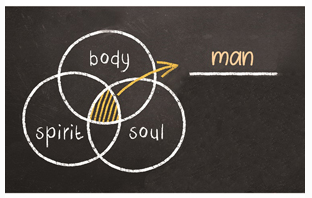
Throughout this study Chambers identifies three essential aspects of human design: spirit, soul, and body. In other words, the author of the best selling devotional book of all time was a trichotomist. Here are sample excerpts.

In reference to the creation account in Genesis

“God breathed into man’s nostrils the breath of life [Genesis 2:7] which became man’s spirit… Thus in man, degenerate or regenerate, there are three aspects, spirit, soul and body.” (p.14)

The distinct aspects and functions of man

“So man’s soul is not his body or his spirit, but is that creation which holds his spirit and his body together, and is the medium of expressing his spirit in his body … it is his spirit that
moulds his body, and his soul is the medium the spirit uses to express itself.” (p.15)

Before and after the fall:

The more you meditate on the verse, [Genesis 3:7 “nakedness” before the fall] the more will you find in it, and there is quite sufficient to indicate this — that when Adam’s spirit, soul and body were in perfect faith and love to God, united to God, his soul was the medium which brought down the marvelous life of the Spirit of God, the very image of God, into his material body and clothed it in inconceivable splendor of light, until the whole man was the likeness of God. Instantly he disobeyed, that went, the connection with God was shut off, and spirit, soul and body tumbled into death… ” (p. 25)

The nature of regeneration

What does regeneration mean? The Holy Spirit lifting man straight back again out of the slough he has got into by death and sin, into a totally new realm, and by sudden intuitions and impulses that new life is able to lift soul and body up … The new birth God has given it is to get it to a place where soul and body will be identified with Christ, until spirit and soul and body are sanctified here and now, and preserved in that condition … by a certain, conscious, superior, moral integrity, transfigured through and through by the union made by the Spirit with God through the atonement of Jesus Christ.” (p. 27)

Dynamics of sanctification and glorification

The uniting of man’s personality, body, soul and spirit, may be brought about in various ways [artificially] … but the Holy Ghost alone through Jesus Christ will do it rightly, this is the only at-one-ment. When our personality is sanctified, it is not God’s Spirit that is sanctified, it is our spirit (1 Thess. 5:23) …” [that is sanctified]. (p.14)

“The marvelous hope before us is that in and through Jesus Christ, our personality in its three aspects is sanctified and preserved in that condition blameless in this dispensation, and that in another dispensation body, soul and spirit will be all instinct with the glory of God.” (p.16).

Conclusion

Oswald Chambers’ discernment of man as spirit, soul, and body was based on a grasp of the whole counsel of God in Scripture. We affirm that this perspective contributed to his profound and influential discipleship teaching.

JBW


[1] https://ourdailybreadpublishing.org/fv162.html

[2] https://ourdailybreadpublishing.org/biblical-psychology.html

Quotations from Chambers’ Biblical Psychology are from the 1914 edition available online at at Internet Archive.

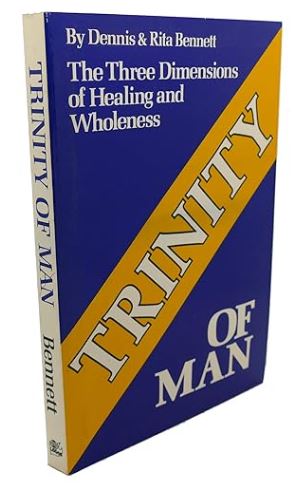
The Trinity of Man

The Trinity of Man was published in 1979 by Logos International (now Bridge Logos). It is rare for a full length book on this topic to be published by a trade publisher. Additional distinctive features of this volume include:

  • It was written by a prominent husband and wife team, Dennis and Rita Bennett, who published other books (separately and together).
  • The first quarter of the book is written in a novel style, introducing the issues of salvation, discipleship, and the model of man.
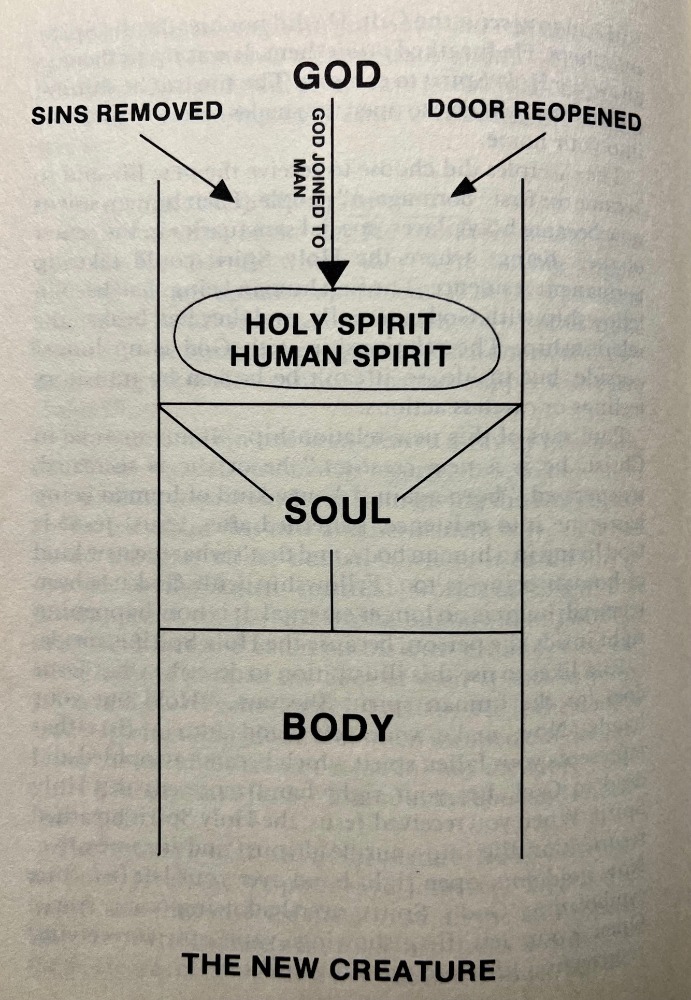
  • In the remaining chapters, the book covers the scope of redemption history and how it relates to man as spirit, soul, and body: creation, the fall, regeneration, and sanctification.
  • This volume is not theoretical, by applied pastoral theology. The orientaion is to engae the reader at a popular level and relate the clarified model of man to discipleship, counseling, and soul healing.
  • Several diagrams are used in the book to illustrate various aspects of biblical anthropology as it relates to unfolding topics addressed.

Since the terms soul and spirit are sometimes used interchangeably, the authors recommend that the reader consult a Greek concordance to do their own New Testament word study. Today that is much easier task using Bible research tools such as BlueLetterBible.org (interlinear tools).

When discussing the topic of spiritual warfare, the authors correctly discern that the human spirit is sealed by the Holy Spirit (Eph. 1:13; 4:30) and secure from demonic attachment. However, the warnings of Ephesians 6:10-18 are very relevant concerning the Enemy’s potential oppression of the believer’s soul and body (chapter 22).


Note about the author’s charismatic orientation

Dennis J. Bennett (1917 – 1991) was an American Episcopal priest. He was born in England but raised in California. Bennett was a seminal figure in the Charismatic Movement within the Christian church.[1] Since 2010 The library of Regent University (Virginia) hosts the collection of these authors.

“In 1966 he [Dennis] married Rita Reed, and soon after, they co-founded the Christian Renewal Association, taught numerous workshops and retreats together, and, eventually, co-authored five books. In 1981, Rev. Bennett was designated a Canon of Honor of the Diocese of Olympia in recognition of his work in the charismatic movement. That same year, he resigned as rector of St. Luke’s to write and conduct seminars and conferences. With his wife Rita, he ministered in evangelism, healing, and church renewal throughout the U.S. and the world. In 2012 he was posthumously awarded an Honorary Doctor of Divinity by Oral Roberts University.”[2]


Although BiblicalPsychology.net does not teach from a Pentecostal/charismatic interpretation of the Baptism of the Holy Spirit and the expected use of speaking in tongues, nevertheless, this book covers the topic of the trinity of man effectively and practically. Readers with a charismatic/Pentecostal view and experience would be even more appreciative of this volume.

JBW


[1] Larsen, Timothy; Bebbington, David; Noll, Mark A. (2015). Biographical Dictionary of Evangelicals. Inter-Varsity Press. p. 45. cf Encyclopedia Britannica

[2] https://libguides.regent.edu/djbennett

Derek Prince on The Triune Nature of Man

Derek Prince (1915-2003) was born in India to British parents and was a scholar of Greek and Latin, attending both Eton College and Cambridge University. At university he described himself as an atheist, but while serving with the British army in World War II, he began studying the Bible and became a Christian.{1]

Derek Prince Publications began in 1971 in Fort Lauderdale, Florida. By 1990 Derek this ministry had expanded, distributing free Bible teaching material had in 140 countries. Currently Derek Prince Ministries has offices in over 45 countries with over 50 books published and translated into more than 60 languages. There is also a large archive of audio and visual material online.[2]

Derek Prince believed and taught man as spirit, soul, and body. I believe this clarity contributed to the popularity and appreciation of his teaching.[3] This view of the nature of man was integral to his teaching as in:

  • What is Man? (2 sessions) Audio CD and MP3
  • Bible Psychology (8 sessions) Audio CD and MP3 Only the mirror of Scripture can reveals to man his own inner nature and restore true harmony. The tabernacle and its furnishings are inspired patterns which reveal the God-ordained functions of spirit, soul and body.
  • The New Creation ( 2 sessions) Audio CD and MP3 How does the new creation affect man’s spirit? His soul? His body? What is the nature of the new man?

Here is a sample recording from Prince’s 10 part series titled “Total Man.”
https://www.derekprince.com/radio/802
Description: God made man of spirit, soul, and body. Today Derek looks at these three parts to define what they are and how they work together. Apart from God, man’s soulish nature tries to run things. The divine connection of man’s spirit to God’s Spirit is necessary for man to become what he was made to be.

After surveying relevant Scriptures (such as Hebrews 4:12; 1 Thessalonians 5:23; Genesis 2:7; 1 Corinthians 15:45), Derek Prince summarized:

“Spirit has life in itself. It gives life. But soul must first receive life from spirit before it can live. So there we have the divine breath of God, the eternal, self-existent breath of God, breathed into that body of clay and the result a living soul a nefesh, something that is essentially dependent on spirit, dependent on God to receive life and to maintain life. So those are the three elements that make up man in his total personality. The spirit from above, the body from beneath and the soul which is produced by union of spirit and body, a living human personality.”

Prince then emphasized the need for biblical revelation to understand the tri-une nature of man. He testified,

“For many years I studied Greek philosophy in the original language, and Greek philosophy, in a certain sense, revolves around the soul. But the interesting thing is that there are none, or almost no words in English that begin with pneuma. And in Greek philosophy, really nothing was ever devoted to that [spiritual] element of man. What does that mean? It means this. That apart from the mirror of God’s revelation, man is aware he has a soul. He’s really unaware of his own spirit. There’s an element in him deeper than his understanding which he cannot plumb, which he cannot fathom, which he can only know about through divine revelation. So again we see that we are absolutely shut up to the mirror of God’s Word if we want to know the truth about ourselves.”

This observation is confirmed in Hebrews 4:12: “For the Word that God speaks is alive and full of power [making it active, operative, energizing, and effective]; it is sharper than any two-edged sword, penetrating to the dividing line of the breath of life (soul) and [the immortal] spirit…” AMPC

JBW


[1] Wikipedia.com

[2] DerekPrince.com

[3] The doctrine of holistic trichotomy of man is not merely theoretical but of great practical value.

Audio and ebook content is available at https://store-us.derekprince.com/

The Use or Misuse of the Trichotomy of Man

One of the objections to the spirit, soul, and body view of man by some biblical counselors is that it can be used to promote psychiatry and psychotherapy and diminish spiritually oriented counseling.

Admittedly, we see an obvious connection of the aspects of man’s makeup with three general approaches to therapy:

  • Body: The psychiatrist has a physical orientation. He/she is an M.D. with advanced training in psychopharmacology and related matters. Their primary modality is to treat disruptive mental and emotional problems with prescribed medication.
  • Soul: The psychotherapist (such as a licensed professional counselor) will have a soul treatment orientation. Even the name conveys this (a combination of the Greek words for soul + treatment).
  • Spirit: The pastoral/biblical counselor has a special concern for spiritual realities (such as regeneration and sanctification). Since secular psychiatry and psychotherapy usually ignore or misinterpret the root cause(s) of mental, emotional and behavioral problems, the pastoral counselor brings biblical revelation to bear on resolving personal and relational conflicts. Sin requires forgiveness, and self-centeredness needs to be replaced with Christ-centeredness (1 John 1:9; Romans 12:1,2; Gal. 2:20).

Since we are advocating holistic trichotomy, we hasten to add that the pastoral counselor should be informed and sensitive to any physical factors and psychological and relational issues that pertain to the therapeutic goals of counseling.

Although spirit, soul, and body are ontologically distinct, they are interrelated in influence and functioning. We need to care for and treat the whole person and his/her relationships.
   
Some Christian integrationist counselors have used the spirit, soul, body distinction to minimize or marginalize biblical counseling. They claim the soul or physical domain as their specialties, bolstered by the status of licensure and —in some districts —preventing non state-licensed helpers from using the title of “counselor.”

Now to the main point of this article: Does the potential misuse of the spirit, soul, and body view of man justify rejecting the doctrine of man as trichotomous? This seems to be the case behind an unnecessary dogmatism in favor dichotomy in some biblical counseling organizations.

          
Answer: If the potential misuse of a doctrine prevents it being received, believed, and taught, other evangelical doctrines would be abandoned.

Examples.

1.The doctrine of the Second Coming of Christ is an important, practical, biblical teaching. For example, 1 Thessalonians 4:15-18:

For this we say to you by the word of the Lord, that we who are alive and remain until the coming of the Lord will by no means precede those who are asleep. For the Lord Himself will descend from heaven with a shout, with the voice of an archangel, and with the trumpet of God. And the dead in Christ will rise first. Then we who are alive and remain shall be caught up together with them in the clouds to meet the Lord in the air. And thus we shall always be with the Lord. Therefore comfort one another with these words.”

However, this doctrine can be misused. Some in Thessalonica became lazy and did not support themselves financially. The context implies that they excused their lack of employment because they were waiting for Christ’s return (2 Thess. 3:6-15).

2. The doctrine of justification by faith apart from works is an important biblical teaching. For example:

“Therefore, having been justified by faith, we have peace with God through our Lord Jesus Christ.” “But to him who does not work but believes on Him who justifies the ungodly, his faith is accounted for righteousness” (Rom. 5:1; 4:5; cf. Ephesians. 2:8,9).

However, this doctrine can be misused. Some accused Paul of discounting good works or excusing sin. In Romans 3:8 Paul answers these critics: “And why not say, ‘Let us do evil that good may come’?—as we are slanderously reported and as some affirm that we say. Their condemnation is just.”

3. The doctrine that the New Covenant believer is not under law, but under grace is an important, practical, biblical teaching.

For example, Romans 6:14b “…for you are not under law but under grace.” (Cf Gal. 3:24,25; 5:1-6).

However, this doctrine can be misused. Note some corrected misunderstandings

  • The apostle Paul was not “a minister of sin” (Gal 2:17).
  • The law is not against the promises of God (Gal. 3:21).
  • The law is not sin (Rom. 7:7), but holy, just and good (Rom. 7:12).
  • We are not antinomian, but need to use the law of God properly (1 Tim. 1:8-11).

Conclusion

These are some examples of biblical doctrines that evangelical Christians agree upon, yet can be misused. There is a crucial difference between articulating accurate Biblical doctrine and clarifying the proper use, or misuse, of it. The first is an ontological issue (being), the latter is a practical issue (doing).

JBW


Scripture quotations are from The Holy Bible New King James Version (Thomas Nelson)

For another article on how man’s spirit, soul, and body relate to counseling approaches, see https://gracenotebook.com/the-doctor-is-in/

Thru The Bible Radio

I am one of many who have listened to episodes of the Thru The Bible broadcast of J. Vernon McGee (1904-1988). Listeners are invited aboard “The Bible Bus.” Consider the scope and influence of this Bible teaching ministry:

“THRU the BIBLE is a Bible study program founded by Dr. J. Vernon McGee. This program started on radio in 1967 and covered all 66 books of the Bible, chapter by chapter, verse by verse, in a five-year period. Dr. McGee had a passion for telling this story of the Bible systematically and believed that staying close to Jesus required staying close to His Word. McGee’s country preaching, simple ways, and endearing mannerisms drew listeners from around the world who were seeking a deeper understanding of God’s Word. Today, THRU the BIBLE continues to tell this simple yet profound story in over 250 languages across nearly every nation on Earth….” 1

Dr. McGee’s Thru the Bible Commentary acknowledges the soul/spirit distinction in these passages:

1 Thessalonians 5:23: “And the very God of peace sanctify you wholly; and I pray God your whole spirit and soul and body be preserved blameless unto the coming of our Lord Jesus Christ.”

“Man is a triune being; body, soul (mind), and spirit. ‘Sanctify you wholly’—not perfectly, but we are to reach a place of maturation. We should not continue to be babes in Christ; we should be growing to maturity.”

Hebrews 4:12: “Piercing even to the dividing asunder of soul and spirit.”

“There are times in the Scriptures when ‘soul’ and ‘spirit’ are used synonymously. There are other passages where it is clear that the soul and spirit are separate and are not the same thing. Only the Word of God can divide soul and spirit. “Of the joints and marrow.” The Word can get right down even in this flesh of ours and make a distinction (see Ps. 32:3). 2

The current doctrinal statement of this ministry also affirms a soul/spirit distinction:

We believe that at death the spirits and souls of those who have trusted in the Lord Jesus Christ for salvation pass immediately into His presence and there remain in conscious bliss until the resurrection of the glorified body when Christ comes for His own, whereupon soul and body reunited shall be associated with Him forever in glory; but the spirits and souls of the unbelieving remain after [physical] death conscious of condemnation and in misery until the final judgment…” 3

JBW


1 https://www.ttb.org/about

2 Thru the Bible: Genesis Through Revelation (5 Volumes. Thomas Nelson, 1981)

3 https://help.ttb.org/en/articles/10708033-the-eternal-state
(emphasis and parenthesis added)

Header image: solar powered Thru The Bible audio with Bible by Megavoice

The Interrelationship of Body, Soul, and Spirit in Human Thinking

by John Woodward

When clarifying the ontological distinctions of body, soul, and spirit, the interrelationship of various aspects of human functioning need to be discerned.

How do body, soul, and spirit cooperate in the process of human cognition?

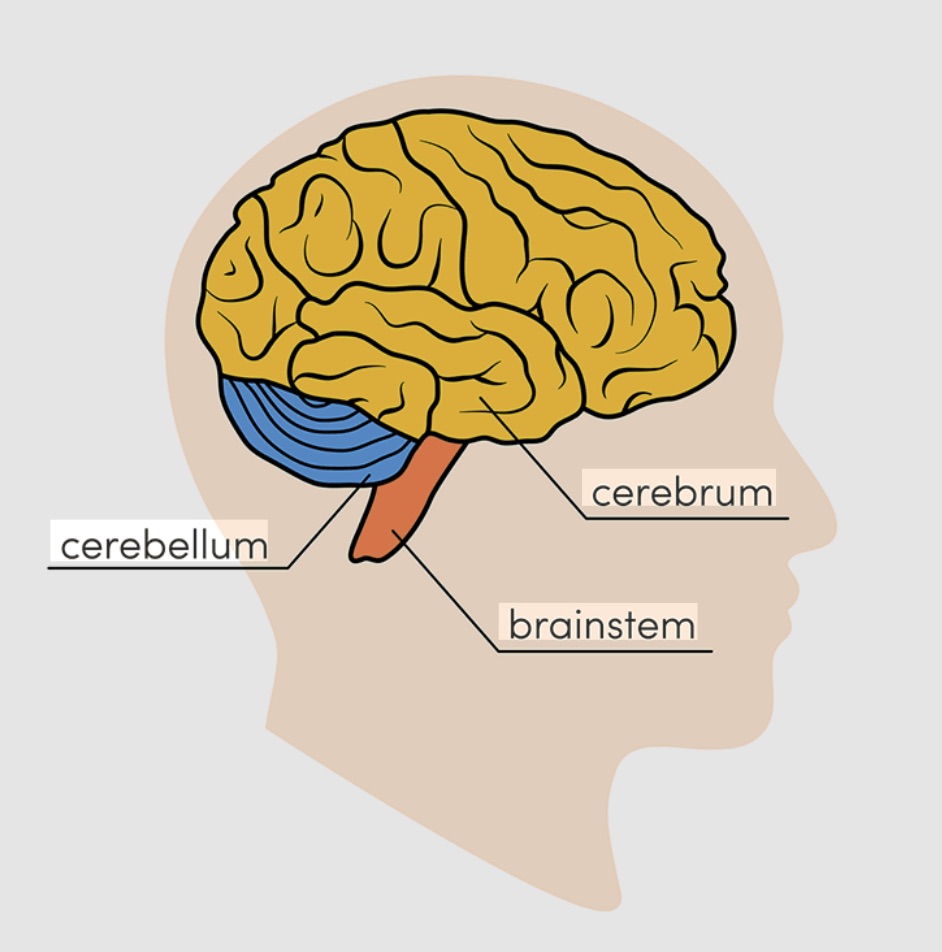
  1. The body’s primary agent in thinking is the marvelous human brain.

Dr. Caroline Leaf specializes in brain research and counseling materials that emphasize the role of the brain in learning and improving mental health. In describing her book, Switch on Your Brain, she writes:

“The Switch On Your Brain with the 5-Step Learning Process® is comprised of five extremely important steps. Each step is designed to take advantage of a particular brain process – all collectively moving toward the goal of learning and mind management…Captured within the 5-Step Learning Process® system is the same “thinking-to-understanding” mental process which will forever change the way you learn and will stretch your potential to untold horizons. This approach is solidly based on the latest scientific research on the neurological and neurophysiological functioning of the brain. It draws on the neuroplastic (ability to change) character of the brain and is designed to take best advantage of the symphony of electrochemical reactions and actions occurring in the brain at a rate of 400 billion per second. One of the most exciting facts about the “plastic” brain is that the brain is never quite the same with every new piece of information we learn.” [1]

However, it is biblically and medically obvious that thinking is not limited to the brain.

“For out of the heart [not brain] proceed evil thoughts…” (Matthew 15:19).

For example, with Alzheimer’s disease, dementia symptoms gradually worsen over a number of years. In its early stages, memory loss is mild, but with late-stage Alzheimer’s, individuals lose the ability to carry on a conversation and respond to their environment [A.I. summary]. However, this decline in cognitive functioning (and sometimes a negative change in personality) is not caused by a person’s psychological thinking or choices.

  1. The soul is the seat of man’s responsible thinking.

The faculties of the soul are typically listed as mind, will, and emotions. One of the lines of evidence for this categorization is the observation that animals (such as a pet dog or cat) exhibit these faculties, whereas plants (that have material life) do not. On the other hand, humans are made in God’s image; this includes having a distinct human spirit, with its higher cognitive potential and moral responsibility (Genesis 1:27; 2:7).

The soul/spirit distinction is shown in the subtle—yet important—distinction between psychological and spiritual knowledge. For example, a believer exercising the true gift of tongues (an unlearned language) might pray in the spirit, yet not have cognitive understanding at the soul level (1 Corinthians 14:14,15).

  1. The condition of a person’s spirit influences their capacity to think wisely.

A. Examples of negative spiritual influences on the mind

The unsaved person cannot understand the full meaning of God’s word due to his unregenerate spirit. “The natural [literally ‘soulical’] person does not accept the things of the Spirit of God, for they are folly to him, and he is not able to understand them because they are spiritually discerned” (1 Corinthians 2:14).

Satan blinds the mind of unbelievers (2 Corinthians 4:4).

B. Examples of positive spiritual influences on the mind

“Then he [Jesus] opened their minds to understand the Scriptures” (Luke 24:45).

After the man from the area of the Gadarenes was delivered of a legion of demons, he was clothed and “in his right mind” (Luke 8:35).

C. The mind of Christ for the believer: provided and progressive

The soul/spirit distinction in thinking is also significant in comparing Scriptures about the mind of Christ.

Possessed already in the spirit

“…But we have the mind of Christ” (1 Corinthians 2:16b). This text states that believers have (present tense) the “mind [Greek, nous] of Christ” This relates to their regenerated spirit, with the restored faculty of intuition (the ability to receive spiritual truth).

Yet, at the soul level, mind renewal is continually needed.

Progressively developed in the soul

“Let this mind be in you which was also in Christ Jesus…” (Philippians 2:5). This is an admonition, as is Romans 12:1,2:

“I beseech you therefore, brethren, by the mercies of God, that you present your bodies a living sacrifice, holy, acceptable to God, which is your reasonable service [Greek latreia, with the connotation of spiritual/worshipful service]. And do not be conformed to this world, but be transformed by the renewing of your mind [Greek, nous], that you may prove what is that good and acceptable and perfect will of God.”

Better thinking in the soul may help a person, but only God’s Spirit can continue to transform the believer (2 Cor. 3:18).

It is hoped that this brief overview gives further support for holistic trichotomy. The material and immaterial dimensions of the human mind are mysteriously interrelated, yet the physical, psychological, and spiritual aspects of man’s thinking are distinct.


[1] https://drleaf.com/pages/research-history

The Hidden Man

E. W. Kenyon wrote extensively on faith and the deeper life. (This post is not intended to evaluate all his views, but to note his influence as an author and educator, and to observe his explicit belief in trichotomy.)

Wikipedia gives a summary of Kenyon’s life and ministry:

Essek William Kenyon (1867–1948) was a pastor of the New Covenant Baptist Church and founder and president of Bethel Bible Institute in Spencer, Massachusetts. It remained in operation until 1923. He was its president for twenty-five years. The school later moved to Providence, Rhode Island, and became Providence Bible Institute. It later became Barrington College and merged with Gordon College, which was named after one of Kenyon’s many mentors, A. J. Gordon. It is now known as Gordon College.

Essek William Kenyon (1867–1948) was a pastor of the New Covenant Baptist Church and founder and president of Bethel Bible Institute in Spencer, Massachusetts. It remained in operation until 1923. He was its president for twenty-five years.

The school later moved to Providence, Rhode Island, and became Providence Bible Institute. It later became Barrington College and merged with Gordon College, which was named after one of Kenyon’s many mentors, A. J. Gordon. It is now known as Gordon College.[1]

Here is an example of Kenyon’s view of the model of man.

The Spirit of Man

It is a remarkable fact that the church has never majored [on] man’s spirit, or that man is a spirit. Modern psychology denies that man is a spirit, and in the place of the spirit, he gives us the “subconscious mind”. What he has discovered, and calls the “sub-conscious mind,” is man’s spirit.

Man was created in the image and likeness of God. God is a spirit. Man was to be created so that he could become a partaker of God’s nature. If he were to be a partaker of God’s nature, he must be in the same class of being as God. In speaking of the Father and of worship, Jesus said, “God is a spirit and they that worship Him must worship Him in spirit and in truth” [John 4:24]. Only a spirit can worship in spirit.

[Kenyon observed that a person is governed primarily in one of three “realms” that correspond to body, soul, and spirit. He also noted that spirituality could be genuine or counterfeit.]

The natural man described in 1 Corinthians 2:14 is governed in one of three ways. The scholastic man is governed by his reason [soul], the sensuous man is governed by his body, and the spiritual man is governed by his spirit...

If a man is a spirit, and we know that he is, then his spirit should dominate him, but when he [Adam] fell in the Garden, reason took the supremacy. God’s purpose was that man’s spirit should dominate the whole man. Natural spirits can be developed. Spiritualism is the result of a highly developed spirit without God. The religious philosophies are very spiritual, but they are not spiritual in the sense of the New Testament. It is a spirituality of natural man...

A man can have his spirit developed by demons as the spiritualistic cults are developed. He can have his spirit developed by natural means until he becomes very spiritual. The real spirituality is the spirit that has been recreated [2 Cor. 5:17; Eph 4:24], received the life and nature of God, and has been cultivated and trained through the Word. The real food of the spirit is the Word of God. Matthew 4:4, “Man shall not live by bread alone, but by every Word that proceedeth out of the mouth of God.”

The Bible is not the food for the brains primarily, not food for the body, but basically it is food which God planned to feed our spiritual natures upon.[2]


[1] https://en.wikipedia.org/wiki/E._W._Kenyon

[2] The following is an excerpt from an article in Kenyon’s newsletter at his legacy web site, https://www.kenyons.org / These themes are developed in Kenyon’s book, The Hidden Man
https://www.whitakerhouse.com/

Bracketed content added – JBW

Differentiating Soul and Spirit

by Dr. JAMES FOWLER

“Now may the God of peace Himself sanctify you entirely; and may your spirit and soul and body be preserved complete, without blame at the coming of our Lord Jesus Christ. Faithful is He who calls you, and He also will bring it to pass.”
(1 Thessalonians 5:23-24)

To properly understand the work of Jesus within the Christian, as He functions conjunctively as Lord and Savior, requires a differentiation of spirit and soul – of our spiritual condition and psychological behavior.

What a disservice theology has done for centuries by attempting to amalgamate spirit and soul as synonymous terms, even to the extent of regarding their differentiation as heretical.
The biblical evidence sufficiently differentiates these differing functionalities of our humanity. Writing to the Thessalonians, Paul indicated that to be “sanctified entirely,” our “spirit and soul and body must be preserved complete” (I Thess. 5:23). The writer to the Hebrews notes, “The word of God is living and active and sharper than any two-edged sword, piercing as far as the division of soul and spirit . . . and able to judge the thoughts and intentions of the heart” (Heb.4:12).

When we fail to differentiate spiritual function and psychological function, we end up with a mushy merging of psychologized spirituality or spiritualized psychology. Christians are left with an inability to explain the fixed condition of their spiritual union with the Spirit of Christ, alongside of the behavioral conflict in their soul. This is the breeding ground of the false identities, insecurity, and hypocrisy, which are rampant in the contemporary Christian community.

Our Spiritual Condition

Many Christians have not understood what was brought into being in their spirit by spiritual regeneration. Jesus told Nicodemus, “You must be born again,” explaining, “that which is born of the Spirit is spirit” (John 3:5,6). If the life of the risen and living Lord Jesus has not been birthed in our spirit, then we are not Christians. “If any man does not have the Spirit of Christ, he is none of His” (Rom. 8:9), Paul wrote. On the other hand, if we have received the life of the Spirit of Christ, “the Spirit bears witness with our spirit that we are children of God” (Rom. 8:16).
Christians are those who are “born again to a living hope through the resurrection of Jesus Christ from the dead” (I Peter 1:3). They are “alive unto God in Christ Jesus” (Rom. 6:11), with the very resurrection-life of Jesus dwelling in them. A spiritual exchange has been enacted whereby they have been “converted from darkness to light and from the dominion of Satan to God” (Acts 26:18). Previously we “were by nature children of wrath” (Eph. 2:3), but now the Christian has “become a partaker of the divine nature” (II Peter 1:4). This is a radical spiritual exchange, not to be considered as a joint-tenancy of two natures that allows for a dualistic and schizophrenic basis of identity, as well as a paranoid uncertainty of servitude. “No man can serve two masters” (Matt. 6:24), Jesus declared.

Much of the evangelical emphasis on being “born again” has been shallow and misleading. People have been led to think that just because they have raised their hand, walked an aisle, and repeated a creedal statement, they are promised a ticket to heaven with the future guarantee of eternal life. Christianity becomes an “escape hatch” or a “fire insurance policy” to avoid the terrifying threat of hell-fire.

If this is the extent of what it means to be “born again,” then it is no wonder that many have accepted the possibility of being spiritually “still-born,” with no life expression of growth, maturity, and developing sonship. Such a suggestion of spiritual “still-birth” is not far removed from that of “spiritual abortion” whereby those who are unwilling to go through the labor and pain of Christ being formed in them (Gal. 4:19) participate in the abortion of Christ’s life, though they might be adamantly opposed to physical abortion.

It is imperative that Christians understand that we are spiritually regenerated when we receive Jesus into our spirit, when His very Being is present and active in the spiritual core of our being.

“This is the mystery,” Paul advised the Colossians, “Christ in you, the hope of glory” (Col. 1:27). He questioned the Corinthians, “Do you not recognize that Jesus Christ is in you – unless you fail the test?” (II Cor. 13:5). “It is no longer I who live,” he explained to the Galatians, “but Christ lives in me” (Gal. 2:20).

But even this glorious truth of the indwelling Christ in the Christian can degenerate into mundane statements of the location and placement where Jesus is deposited as a static commodity, failing to understand and appreciate that the living Lord and Savior, Jesus Christ, has become our life (cf. Col. 3:4).

This dynamic of divine life within the Christian disallows spiritual regeneration to be viewed as a static end in itself, and requires that we view regeneration as an initial receipt of the life of Christ, which must be dynamically lived out in our behavior. Regeneration is a crisis with a view to a process.

The spiritual relationship that the Christian has with Jesus Christ as Lord and Savior must not be viewed as a casual acquaintance. In its broadest definition, a “relationship” is merely the locative proximity of two or more objects. The personal relationship of the Christian and Christ, however, is a dynamic relationship that goes beyond placement and proximity to a relational union with Christ.

“The one who joins himself to the Lord is one spirit with Him” (I Cor. 6:17). This is not an essential oneness of equivalence, but a relational union of interactive conjunction, wherein the character of God is allowed expression in human behavior.

Thomas Merton wrote, Christian holiness is not a mere matter of ethical perfection. Sanctity is not constituted only by good works or even by moral heroism, but first of all by ontological union with God “in Christ.” Our ontological holiness is our vital union with the Holy Spirit.

When the Christian is spiritually regenerated – i.e., brought into being again with the life of Jesus in the individual, and that facilitated by the receptivity of faith – a relational spiritual union is established that must allow for the outworking of Christ’s life in the Christian’s behavior.
Everything becomes new for the Christian. “If any man is in Christ, he is a new creature; the old things passed away; behold, new things have come” (II Cor. 5:17). Whereas once we were identified as an “old man” (Rom. 6:6; Eph. 4:22; Col. 3:9), we have been spiritually transformed into a “new man” (Eph. 4:24; Col. 3:10). The “old man” identity has been crucified (Rom. 6:6), “put off” (Eph. 4:22; Col. 3:9), and eradicated – replaced by the “new man” identity of Christ’s presence in our spirit, allowing us to participate in “newness of life” (Rom. 6:4).

The “new heart and new spirit” that Ezekiel prophesied (Ezek. 36:26) has been given to us by the presence of the Spirit of Christ in our spirit. This was not a “heart transplant” or a “parts replacement,” but the enlivening of our spirit by Christ’s life as the “law of God is written on our hearts” (Heb. 8:10; 10:16).

The Christian is not just redeemed, a “sinner saved by grace,” but the Christian is restored to God’s intent for mankind.

We have “all things in Christ” (I Cor. 3:21-23), “all things pertaining to life and godliness” (II Peter 1:3), “every spiritual blessing in heavenly places in Christ Jesus” (Eph. 1:3). We are “complete in Christ” (Col. 2:10).

We need to be aware of our spiritual identity as “sons of God” (Gal. 3:26), “children of God” (John 1:12; I John 3:10), and “saints” (Rom. 8:27: Eph. 1:18; 4:12), who are now “godly” (II Peter 2:9), “righteous” (Eph. 4:24; II Cor. 5:21), and “perfect” (Phil. 3:15; Heb. 12:23).

Every facet of Christ’s character is available to us in the “fruit of the Spirit” (Gal. 5:22,23), and the entirety of His functional ministry is made available via the charismata, the gifts of the Spirit.
Everything that God wants us to have, for everything that He wants to do in us, is accorded to us by the indwelling presence and function of the living Lord Jesus.

The saving activity of the Savior has been completed in reference to the spiritual condition of every Christian. “For by grace you have been saved through faith” (Eph. 2:8). Spiritually, the Christian has been “made safe” from the dysfunction of satanic misuse and abuse. We are “safe sons,” who are “dead to sin, but alive to God in Christ Jesus” (Rom. 6:11), and the Christ Who lives in us and has become the basis of our identity “does not sin” (I John 3:9), allowing for the possibility that we “may not sin” (I John 2:1).

The perfection of our spiritual condition must not, however, obscure the ongoing activity of Christ the Savior in our soul.

As “new creatures in Christ, all things have become new” (II Cor. 5:17) spiritually, but this is not to deny or disallow that there is a continued renewing (cf. Rom. 12:2; Eph. 4:23) still necessitated in the soul.

Joshua’s victory at Jericho still required the people of God to “take the land and overcome the strongholds.” In like manner, we who “have been saved” (Eph. 2:8) must still be “saved by His life” (Rom. 5:10). We who are “perfect” (Phil. 3:15) must still be “perfected” (Phil. 1:6; Col. 1:28). We who are spiritually “made righteous” (Rom. 5:19) must “present our members as instruments of righteousness to God” (Rom. 6:13).

Paul explained that the “new man” (Col. 3:10) continues to be renewed as he allows Christ to overcome the old ways of “anger, abusive speech, lying,” etc. (Col. 1:8,9).

Published online through IOMAmerica.net

James Folwer has authored over 20 books and manages http://christinyou.net/

A Biblical Question Answered

This is an excerpt from a respected topical book, 1001 Bible Questions Answered. The publisher notes:

“Serious students of the Word of God will find answers to questions in 43 categories. In this well-researched book, Pettingill goes to the original sources and puts things into the proper context in examining the “difficult” questions not found in a super-level reading of the Bible. The questions are answered from a dispensational perspective.” [1]

The author(s) answer this question: Please explain the difference between the soul and the spirit…

  1. Man has a body. In this he is like all the creation of God throughout the animal and vegetable world. The brutes have living bodies, and so do the trees and plants.
  2. Man has a soul. In he is unlike the trees and plants, but he is like the lower animals. The soul is the seat of the emotions, the passions, the feelings, the desires, the desires, the likes and dislikes, the affections, and the will. All these things we have in common with the beasts.
  3. Man has a spirit. In this he is unique among God‘s creatures. “The spirit of man is the candle of Jehovah” (Proverbs 20:27), and it is this that is set aglow when he is born again; and then God Spirit testifies with man’s spirit that he is a child of God. God cannot be known by the body, nor by the soul, but only by the spirit. And even the human spirit is incapable of finding out anything about God or of knowing God except by revelation of the Spirit of God. “For what man knoweth the things of a man, save the spirit of man which is in him? even so the things of God knoweth no man, but the Spirit of God. Now we have received, not the spirit of the world, but the spirit which is of God; that we might know the things that are freely given to us of God. Which things also we speak, not in the words which man’s wisdom teacheth, but which the Holy Ghost teacheth; comparing spiritual things with spiritual. But the natural man receiveth not the things of the Spirit of God: for they are foolishness unto him: neither can he know them, because they are spiritually discerned. But he that is spiritual judgeth all things, yet he himself is judged of no man” (1 Cor. 2:11–15). The believer is spiritual only when he has ruled through his own spirit by the Spirit of God. If he is ruled by his body as dominated by his soul, he becomes a slave to his own affections, appetites, emotions, passions, and therefore is a willful, selfish man. The Word of God is extremely careful to distinguish between things of the soul and of the spirit, even judging “the thoughts and intents of the heart“ as to whether such thoughts and intents are spiritual or soulish (Hebrews 4:12). It declares that any wisdom which is not from above and therefore not from the Spirit of God, is earthly, soulish, devilish“ (James 3:15). It asserts that the false teachers of the end time are “they who make separations, soulish, not having the Spirit“ (Jude 19); and that having not the Spirit, they are “none of his“ (Rom. 8:9). And, finally, it gives us the glorious assurance that when we get our resurrection bodies (1 Cor. 15:44) they will be no longer be soulish (“natural” is incorrect here also), but spiritual: no longer dominated by selfishness and willfulness, but rather under the full and free control of the Spirit of God.[2]

The primary author was Pettingill. Both authors were leading figures in Bible institutes.”William Pettingill (1886-1950) was an American pastor, educator, and lecturer. In 1913, C. I. Scofield and Pettingill co-founded the Philadelphia College of the Bible, with Pettingill serving as dean. He wrote widely, served on the council of the Central American Mission, and was a staunch supporter of the fundamentalist movement … From 1928 to 1950, Dr. Pettingill traveled across North America, Central America, and Europe sharing his gift of stirring people to action from the word. “Keep looking up!” was his motto and it became the challenge to many.


______________

[1] e-Sword Bible software
http://www.biblesupport.com/e-sword-downloads/file/9343-pettingill-william-900-bible-questions-answered/

[2] William L Pettingill and R.A. Torrey, 1001 Bible Questions Answered, (New York: Bristol Park Books, 2011), 388-89.

Salvation of the Soul: Saving of the Life

“The spirit of a man is the lamp of the Lord,
Searching all the inner depths of his heart.” Proverbs 20:27

Arlen L. Chitwood’s book, Salvation of the Soul: Saving of the Life, presents an explicit body/soul/spirit view of man. He graduated from Tennessee Temple and completed is formal education at Bob Jones University. Chitwood is a preacher and author of many books, publishing through The Lamp Broadcast based in Oklahoma.

Chapter one has the subheading, “The Tripartite Nature of Man.”

“And the very God of peace sanctify you wholly; and I pray God your whole spirit and soul and body be preserved blameless unto the coming of our Lord Jesus Christ” (I Thess. 5:23). Chitwood is explicit in applying this model of man:

“Man is a tripartite being comprised of spirit, soul, and body; and the salvation of man within its complete scope (past, present, and future) pertains to the salvation of man with respect to his complete being” (p. 3).

Chitwood gives a thorough explanation of creation, the fall, regeneration, sanctification and future glorification as clarified by the makeup of man. Regarding the Fall and regeneration, for example, he notes:

“The death of Adam’s spirit separated him from God (establishing the primary meaning of “death” in Scripture — separation from God), and this death (this separation from God) “passed upon all men” (Rom. 5:12). Scripture speaks of an unsaved person as being “dead in trespasses and sins” (Eph. 2:1). With an unredeemed, inanimate spirit (spiritually dead), he is alienated from God, separated from God (Eph. 2:12). But once the person has been born from above, he is then spoken of as having passed “from death unto life,” as having been “quickened” (John 5:24; Eph. 2:5). Possessing an animate spirit, possessing spiritual
life (having been made alive spiritually), he is no longer separated from the One Who Himself is “Spirit” (John 4:24)” (p. 7).

Regarding the soul/spirit distinction he observes,

“And Scripture also carefully distinguishes between salvation in relation to the spirit and salvation in relation to the soul. Salvation in relation to the spirit is ALWAYS dealt with in a past sense, BUT not so with the salvation of the soul. Rather, the salvation of the soul is ALWAYS dealt with in present and future senses:
“Receiving the end of your faith, even the salvation of your souls” (I Peter 1:9).
“Wherefore lay apart all filthiness and superfluity of naughtiness, and receive with meekness the engrafted word, which is able to save your souls” (James 1:21).” (p. 8).

Noting the three tenses of salvation Chitwood summarizes:

Within man’s triune being (body, soul, and spirit [I Thess. 5:23]), the eternal salvation which he either already has or can have through faith in Christ has to do, during present time, with his “spirit” alone, not with his “soul” or “body” (John 3:6). Salvation in Scripture is seen inseparably associated with the complete gospel message, the complete preaching of the cross, the complete man (spirit, soul, and body) comprising past, present, and future aspects of all. We have been saved (past, having to do with “the spirit”), we are being saved (present, having to do with “the soul”), and we are about to be saved (future, having to do with the realization of the salvation of “the soul,” along with “the body”). (p. 161)

A major orientation of his writings is the Kingdom of God, especially in its future expression.


Arlen L. Chitwood, Salvation of the Soul: Saving of the Life, The Lamp Broadcast, 1983; revised 2020. www.lampbroadcast.org/pdfbooks.html