Unknown's avatar

About jbwoodward

John serves as Director of Counseling and Training for Grace Fellowship International. His main article archive is GraceNotebook.com

The True Nature of the Fall

This excerpt from Watchman nee’s devotional classic, The Normal Christian Life, includes the spirit/soul/body distinction:

[Let us] go back … to Genesis and consider what it was that God sought to have in man at the beginning and how His purpose was frustrated. In this way we shall be able to grasp the principles by which we can come again to live in line with that purpose.

If we have even a little revelation of the plan of God we shall always think much of the word ‘man’. We shall say with the Psalmist, “What is man, that thou art mindful of him?” The Bible makes it clear that what God desires above all things is a man—a man who will be after His own heart.

So God created a man. In Genesis 2:7 we learn that Adam was created a living soul, with a spirit inside to commune with God and with a body outside to have contact with the material world. (Such New Testament verses as 1 Thessalonians 5:23 and Hebrews 4:12 confirm this threefold character of man’s being.) With his spirit Adam was in touch with the spiritual world of God; with his body he was in touch with the physical world of material things. He gathered up these two sides of God’s creative act into himself to become a personality, an entity living in the world, moving by itself and having powers of free choice. Viewed thus as a whole, he was found to be a self-conscious and self-expressing being, “a living soul”.

We saw earlier that Adam was created perfect—by which we mean that he was without imperfections because created by God—but that he was not yet perfected. He needed a finishing touch somewhere. God had not yet done all that He intended to do in Adam. There was more in view, but it was as yet in abeyance. God was moving towards the fulfillment of His purpose in creating man, a purpose which went beyond man himself, for it had in view the securing to God of all His rights in the universe through man’s instrumentality. But how could man be instrumental in this? Only by a co-operation that sprang from living union with God. God was seeking to have not merely a race of men of one blood upon the earth, but a race which had, in addition, His life resident within its members. Such a race will eventually compass the downfall of Satan and bring to fulfillment all that God has set His heart upon. It is that that was in view with the creation of man.

Then again, we saw that Adam was created neutral. He had a spirit which enabled him to hold communion with God; but as man he was not yet, so to speak, finally orientated; he had powers of choice and he could, if he liked, turn the opposite way. God’s goal in man was ‘sonship’, or, in other words, the expression of His life in human beings. That Divine life was represented in the garden by the tree of life, bearing a fruit that could be accepted, received, taken in. If Adam, created neutral, were voluntarily to turn that way and, choosing dependence upon God, were to receive of the tree of life (representing God’s own life), God would then have that life in union with men; He would have realized ‘sonship’. But if instead Adam should turn to the tree of the knowledge of good and evil, he would as a result be ‘free’ to develop himself on his own lines apart from God. Because, however, this latter choice involved complicity with Satan, Adam would thereby put beyond his reach the attaining of his God-appointed goal.

Now we know the course that Adam chose. Standing between the two trees, he yielded to Satan and took of the fruit of the tree of knowledge. This determined the lines of his development. From then on he could command a knowledge; he ‘knew’. But—and here we come to the point—the fruit of the tree of knowledge made the first man over-developed in his soul. The emotion was touched, because the fruit was pleasant to the eyes, making him ‘desire’; the mind with its reasoning power was developed, for he was ‘made wise’; and the will was strengthened, so that in future he could always decide which way he would go. The whole fruit ministered to the expansion and full development of the soul, so that not only was the man a living soul, but from henceforth man will live by the soul. It is not merely that man has a soul, but that from that day on the soul, with its independent powers of free choice, takes the place of the spirit as the animating power of man.

We have to distinguish here between two things, for the difference is most important. God does not mind—in fact He intends—that we should have a soul such as He gave to Adam. But what God has set Himself to do is to reverse something. There is something in man today which is not just the fact of having a soul, but which constitutes a living by the soul. It was this that Satan brought about in the Fall. He trapped man into taking a course by which he could develop his soul so as to derive his very life from it.

We must however be careful. To remedy this does not mean that we are going to cross out the soul altogether. You cannot do that. When today the Cross is really working in us, we do not become inert, insensate, characterless. No, we still possess a soul, and whenever we receive something from God the soul will still be used in relation to it, as an instrument, a faculty, in a true subjection to Him. But the point is, Are we keeping within God’s appointed limit—within the bounds set by Him in the Garden at the beginning—with regard to the soul, or are we getting outside those bounds?

What God is now doing is the pruning work of the vinedresser. In our souls there is an uncontrolled development, an untimely growth, that has to be checked and dealt with. God must cut that off. So now there are two things before us to which our eyes must be opened. On the one hand God is seeking to bring us to the place where we live by the life of His Son. On the other hand He is doing a direct work in our hearts to undo that other natural resource that is the result of the fruit of knowledge. Every day we are learning these two lessons: a rising up of the life of this One, and a checking and a handing over to death of that other soul-life. These two processes go on all the time, for God is seeking the fully developed life of His Son in us in order to manifest Himself, and to that end He is bringing us back, as to our soul, to Adam’s starting-point. So Paul says: “We which live are always delivered unto death for Jesus’ sake, that the life also of Jesus may be manifested in our mortal flesh” (2 Cor. 4:11).

What does this mean? It simply means that I will not take any action without relying on God. I will find no sufficiency in myself. I will not take any step just because I have the power to do so. Even though I have that inherited power within me, I will not use it; I will put no reliance in myself. By taking the fruit, Adam became possessed of an inherent power to act, but a power which played right into Satan’s hands. You lose that power to act when you come to know the Lord. The Lord cuts it off and you find you can no longer act on your own initiative. You have to live by the life of Another; you have to draw everything from Him.

Oh, friends, I think we all know ourselves in measure, but many a time we do not truly tremble at ourselves. We may, in a manner of courtesy to God, say: ‘If the Lord does not want it, I cannot do it’, but in reality our subconscious thought is that really we can do it quite well ourselves, even if God does not ask us to do it nor empower us for it. Too often we have been caused to act, to think, to decide, to have power, apart from Him. Many of us Christians today are men with over-developed souls. We have grown too big in ourselves. We have become ‘big-souled’. When we are in that condition, the life of the Son of God in us is confined and almost crowded out of action.

Watchman Nee,

The Normal Christian Life, chapter 12: “The Cross and the Soul Life” (bold added for emphasis)

http://www.ccel.org/ccel/nee/normal.xvi.html

The Illustration of an Apple: Three in One

An Apple: Three Parts in One Fruit

apple_partsThe familiar apple presents another three-in-one illustration. An apple can be summarized and divided into three primary parts. 1. The outer part/skin is protective and external. 2. The flesh of the fruit is inner and edible. 3. The seed area is central and reproductive. In this comparison, the skin represents the human body, the fruit’s flesh represents the soul, and the apple seed(s) represent the spirit.
 “Now may the God of peace Himself sanctify you completely; and may your whole spirit, soul, and body be preserved blameless at the coming of our Lord Jesus Christ” (1 Thess. 5:23).

In some sense all these parts are necessary to make a complete apple. Similarly, man comprises body/soul/spirit. (Thus, we speak of the “holistic trichotomy” of man.) Yet, the skin is ontologically distinct from the inner part. Peeling an apple is an obvious and common practice. The skin is protective and usually temporary. The flesh of the apple is designed to have the primary volume and nutrition. Even so, the human body and soul are separable and distinct. The core of this fruit houses the apple seeds. Like the flesh of the apple, the seed area is separate and distinct from the apple’s skin. While having this similarity with the apple’s flesh, the apple seed is ontologically distinct from the fruit’s flesh. If the apple’s flesh is planted, it disintegrates. (This was a big deal to Johnny Appleseed!) However, if the seed is planted, it can reproduce an apple tree. (Also, nutritionists discourage the eating of apple seeds.)

Invariably, when an apple is peeled, the flesh of the fruit will contain the seeds. Similarly, man’s soul contains his spirit; they are always connected. Yet, the soul and spirit are ontologically distinct.

As in the multifaceted view of man, although the three parts listed above can be identified as fundamental, they can be further differentiated and detailed. For example, the outer part has a temporary stem and leaves. The core of the apple has five carpels, or seed pockets, etc. Similarly the Bible identifies additional aspects of man’s inner makeup: mind, will, emotions, intuition, conscience, communion, etc.

By the way, the the core of the apple may be a useful illustration in considering man’s (spiritual) “heart”. Technically, the heart is not a fourth “part” of man. Yet, as the core holds the apple seeds, the heart relates to man’s spirit. (See a study on the heart in the context of the spirit/soul/body model of man.)

Hopefully, this comparison will be a fruitful endeavor!

– John Woodward

The Revived Life

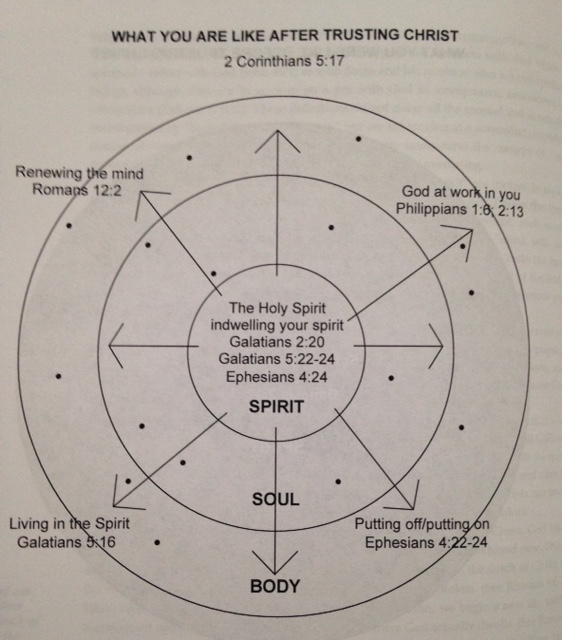
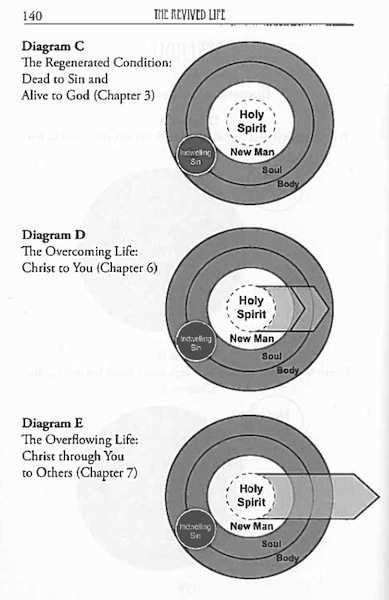
This excellent study on the Abundant Life is biblically sound, doctrinally accurate, and practically applied. The author (with RevivalFocus.com) uses an explicit spirit/soul/body model of man.

revived_life
.

revivedlife_diagram

.

Would you categorize your daily life as abundant? If not, why?

“Greater than any craving for food and water is the deep longing within the soul of many of God’s children to be like Jesus—to be holy and victorious over evil and to be loving and effective in service,” says John Van Gelderen. “In a word, to experience Christ’s life.”

If you’ve felt these longings, but are discouraged and defeated, separated from the life of Christ by the rising waters of failure, John provides hope and help. Laying down biblical stepping stones, he leads you on a journey to a life that overcomes sin and overflows into ministry to others—The Revived Life.

This book combines the brokenness truth of Roy Hession, the Spirit-filled life truth of Watchman Nee, and the spiritual warfare truth of Jesse Penn-Lewis.

from clcpublications.com

A System of Biblical Psychology – free online

delitzschBibleStudyTools.com has added a classic volume to their digital library. One of the most influential, scholarly treatments of man as spirit, soul and body is A System of Biblical Psychology, by Franz Delitzsch. (Trans. Robert E. Wallis. 2nd, English ed. Edinburgh: T. & T. Clark, 1885.) The clarifications to the doctrine of sanctification in Delitzsch have enriched many, including Evan Hopkins who wrote The Law of Liberty in the Spiritual Life (which represented the essential message of the early Keswick Convention in England). Sign up for a free account and access A System of Biblical Psychology and other resources at BibleStudyTools.com

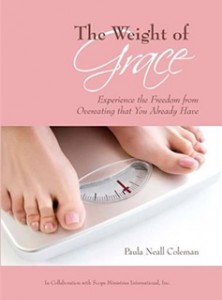
The Weight of Grace

weight_of_grace_cover2-222x300

The subtitle of this workbook is Experience the Freedom from Overeating that You Already Have.

The author, Paula Coleman, includes a spirit/soul/body model of biblical psychology in this study–a Christ-centered approach to overeating / weight loss.

wog_tri

“The Weight of Grace can be used by individuals or small groups and contains an easy-to-use facilitator’s guide.  It is formatted in workbook style with spaces provided where women can write answers to application questions.” www.weightofgrace.org

A Novel Description

One’s biblical psychology is important in describing the physical, psychological, and spiritual aspects of people. This not only the case in devotional or academic literature; it’s also relevant in fiction.

cross_roadsThe novel Cross Roads, by William Paul Young, goes to great lengths to describe the inner life and sanctification process of the main character, Tony who—for most of the book–is in a coma.

In this book, the way a person is described as three-in-one is basically in line with the holistic trichotomy perspective of this blog site. Briefly stated, man has three ontologically distinguishable parts (spirit, soul, and body), yet with two separable aspects (material and immaterial), yet one in personhood.

Chapter eight of Cross Roads is titled, What is the Soul of a Man?

The dream state character who symbolizes the Holy Spirit answers the main character, Tony:  “Trying to explain a human being… a being who is a unity, one, and yet comprising spirit, soul, and body, is like trying to explain God: Spirit, Father, and Son. The understanding is in the experience and relationship…

“Cabby [a mentally handicapped boy], like you, is a spirit interpenetrating a soul interpenetrating a body. But it is not simply interpenetration. It is dance participation… Anthony, like you, Cabby’s body is broken and his soul is crushed and bent, yet his spirit is alive and well. But even though alive and well, his spirit is submitted in relationship to the broken and crushed parts of his person, his soul and body.  Words are very inadequate to communicate sometimes.… You are an interpenetrated and interpenetrating whole, a unity of diversity but essentially a oneness.…

[Cabby’s] brokenness is just more obvious than yours. He wears it on the outside for all to see, while you have kept yours all locked away and hidden as best you know how. Cabby has internal sensitivities and receptors that are significantly more developed than yours. He can see things that you are blind to, can pick up on the good and the danger in people quicker than you, and his perception is much keener.  It is housed in an inability to communicate, a broken body and soul reflective of a broken world.” (New York: Faith Words, 2012, p.113,114)

Although Young (who also wrote The Shack) sometimes stretches imagination to the brink of unorthodoxy, he does a superb job dramatizing the complex process of the main character’s journey of faith, repentance and spiritual growth.


Premarital Counseling Resource

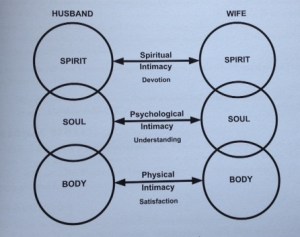
The premarital Counseling workbook from Victorious Christian Living features clear explanation of the spirit/soul/body perspective of man’s makeup. By revealing God’s design, the course teaches the three dimensions of the marital relationship:

Invitation 2 Intimacy
“This premarriage counseling course gives couples the essential tools for experiencing a healthy, long lasting and fulfilling marriage. It is based on the discipleship series entitled SALT (Seven Areas of Life Training®) and was written by ministry mentors and life coaches with over 30 years of experience in preparing couples for marriage. The lessons help couples communicate effectively, forgive each other, resolve conflicts, deal with finances and develop good parenting skills.”

The Greatest Life

Jesus_Greatest_LifeJesus Christ: The Greatest Life Ever Lived

“All four Gospels in the Bible describe the story of the life of Christ-Matthew, Mark, Luke, and John-are inspired, critically important and able to stand alone. Each was written to a particular audience to portray a unique aspect of Jesus’ life. When these four reports are combined into one complete flowing narrative, we gain new insights. This combined account gives us the chronological order of every known fact about Jesus’ life and the teachings found in the four Gospels. Including every chapter and verse with nothing added and nothing left out.”

This scholarly book combines two previously published volumes (that were copyrighted by Western Conservative Baptist Theological Seminary). Johnson Cheney made a detailed study of the Gospels in Greek. Stanley Ellisen Th.D  worked closely with him on the first edition. In the passage on the temptations Jesus encountered (Matthew 4; Luke 4), they authors refer to Christ being tempted in “body, soul, and spirit” (page 41). Note the correspondence: the temptation to make stones into bread (body), the temptation to throw Himself from the top of the Temple (for instant recognition–soul), and the temptation of being given rule over the kingdoms of the world if He would worship the Devil (spirit).

Altar’d

Altard“We are created to live in an altar’d state—surrendered, yielded, free. The noun altar is usually understood to be a place of worshipful offering. Something of value is offered up and released on the altar. When we turn the noun altar into a verb—altar our fear, our failure, our possessiveness, our need to control—all those things that hold us captive and keep us from running the race at full throttle are released. Through careful exposition and biblical teaching, celebrated author and prayer expert Jennifer Kennedy Dean guides readers on a 40-day exploration of the Scriptures and what it means to truly live a life dead to flesh and alive to the spirit. Let the altar do its work in you, transforming fear to faith, worry to worship. Each time that old pattern starts asserting itself in your thoughts, overlay it with the new reality: I’m altar’d. Jennifer is known for her imaginative reframing of eternal truth, and again she gives us a powerful revision of an ancient symbol. She first introduced us to the difference between a prayer life and a praying life, and now leads us to the power of living in an altar’d state. ”
– From Praying Life Foundation

This is an excellent, insightful Bible study. Jennifer also uses the “spirit, soul, body” perspective to give additional clarity to the process of practical sanctification. For a ordering information and  sample chapter, click here. -JBW