
Over a century ago Dr. S.H. Kellogg wrote a 28 page scholarly journal article titled Trichotomy: Biblical Study.
The author introduced
Dr. Kellogg (1839-1899) was a Presbyterian minister and missionary to India. He graduated from Princeton and after 1864 served the Lord as a missionary to India. The Dictionary of Christian Biography in Asia recorded this about his knowledge and ministry:
[After 1879] He spent the next 15 years in the US and Canada, pastoring two large churches, the Third Presbyterian Church in Pittsburgh and the St James Square Presbyterian Church in Toronto. In between, he had a tenure at the Presbyterian Theological Seminary, Allegheny, Pa. … Kellogg also published profusely and was prominent in the General Assembly’s work of the Presbyterian Church of Canada. His book The Jews, or Prediction and Fulfilment, an Argument for the Times was favourably received. The Light of Asia and the Light of the World appeared in 1885 and was pronounced “critical, scholarly and brilliant”. One critic said that there was no other book in the English language which filled exactly its place as a thoroughly comprehensive and clearly discriminating comparison of the legend, doctrines and ethics of Buddha and of Christ. In 1892, Kellogg received a call to return to India to assist in the revision of the Hindi translation of the Old Testament. All the stakeholders in the project felt that he had special qualifications for this work, as he was recognised as an expert in Hindi and was also an accomplished Hebrew scholar.[1]
The article summarized
To begin, it is obvious from Scripture than man has two seperable parts, material and immaterial. However, the important question is whether the human soul and spirit are not merely synonyms, but ontologically distinct. “Stated as a biblical question, the question may put in this form: When the sacred writers speak as they do of body, soul, and spirit, do they mean thereby to denote the soul and spirit being in some sense different and distinct entities, or do these two words simply denote the same thing under two different aspects?” (462).
It is acknowledged the Platonism had a different kind of trichotomy, and Gnosticism and the controversy of Apollinarius (4th century A.D) have created a negative bias regarding the trichotomy of man.[2] However, this is a timely and important subject: “There are many indications that our time, partly as a result of exegesis [and we being] less than in former days under the control of the dogmatic spirit, and still more in consequence of recent discoveries in physiology, the minds many are inclining again to affirm the reality of a true trichotomy in human nature, as attested apparently both by Holy Scripture and modern physiological research” (462).
Kellogg than quotes A.A. Hodge who rejected human trichotomy” The word pneuma designates the one soul, emphasizing its quality as rational. The word psuche designates the same soul, emphasizing its quality the vital and animating principle the body.” Hodge’s argument for this interpretation is as follows: “That the psuche and pneuma are distinct entities cannot be the doctrine the New Testament, because they are habitually used interchangeably and indifferently” (462).
Kellogg’s “Biblical Study” article, then, is primarily based upon testing this conclusion by careful word studies of “soul” and “spirit” in the Old Testament and New Testament.
He noted the importance pf progressive revelation, that we see doctrines in basic form progressively developed over 1,500 years of Genesis to Revelation (pp.463,468).
Kellogg summarized the observations on the usage of nephesh (soul) and ruach (spirit) in the Hebrew O.T. with eight conclusions, including these: “4. While nephesh frequently is used to denote the whole man, soul and body, ruach is never thus employed. Still less can ruach be used, like nephesh, to designate irrational animal, as made up of a soul and a body. 5. While nephesh is even applied the body after the soul has left it, such a usage never occurs with ruach. On the contrary, ruach is contrasted with basar, ‘flesh,’ as something vastly higher (Isa. 31:3)… But finally, whenever the reference is to God or to angels, ruach is always found, and nephesh never. In other words, nephesh is never used except of the immaterial principle as in connection with the animal body (465,66).
The study continues with a detailed study of the Geek words for spirit (pneuma) and soul (psuche) in the New Testament. The classic text is given close examination: “Now may the God of peace Himself sanctify you completely; and may your whole spirit, soul, and body be preserved blameless at the coming of our Lord Jesus Christ” (NKJV). He agrees with Alford’s conclusion about this test: “‘Pneuma is the SPIRIT, the highest and distinctive part of man, the immortal and responsible soul, in our common parlance: psuche is the lower animal soul, containing the passions and desires which we have common with the brutes, but which in us is ennobled and drawn up by the pneuma...'” Kellogg then quotes from Bishop Ellicott who came to the same conclusion in his commentary.
The study proceeds to an examination of soul and spirit as described in 1 Corinthians 15;44 in context. “It [the dead, physical body] is sown a natural body, it is raised a spiritual body. There is a natural [adjectival form of psuche] body, and there is a spiritual [adjectival form of pneuma] body” (NKJV). After discussing the implications of this text, he noted that Charles Hodge (who followed A. A. Hodge in advocating a dichotomy of man) conceded that this text implies a distinction of soul and spirit.
The article continues with a review of additional texts which are considered as confirming evidence of the soul/spirit distinction in man:
“But the natural [adjectival form of psuche] man does not receive the things of the Spirit of God, for they are foolishness to him; nor can he know them, because they are spiritually discerned. But he who is spiritual [adjectival form of pneuma] judges all things” (1 Cor 1:14,15 NKJV). Similarly, Jude 19; 2 Pet. 2:12 are considered.
“For the word of God is living and powerful, and sharper than any two-edged sword, piercing even to the division of soul and spirit, and of joints and marrow [body], and is a discerner of the thoughts and intents of the heart [the functional center of man]” (Heb. 4:12, NKJV).
Dellitzsch (who wrote the full length book affirming human trichotomy, Biblical Psychology) is favorably quoted.
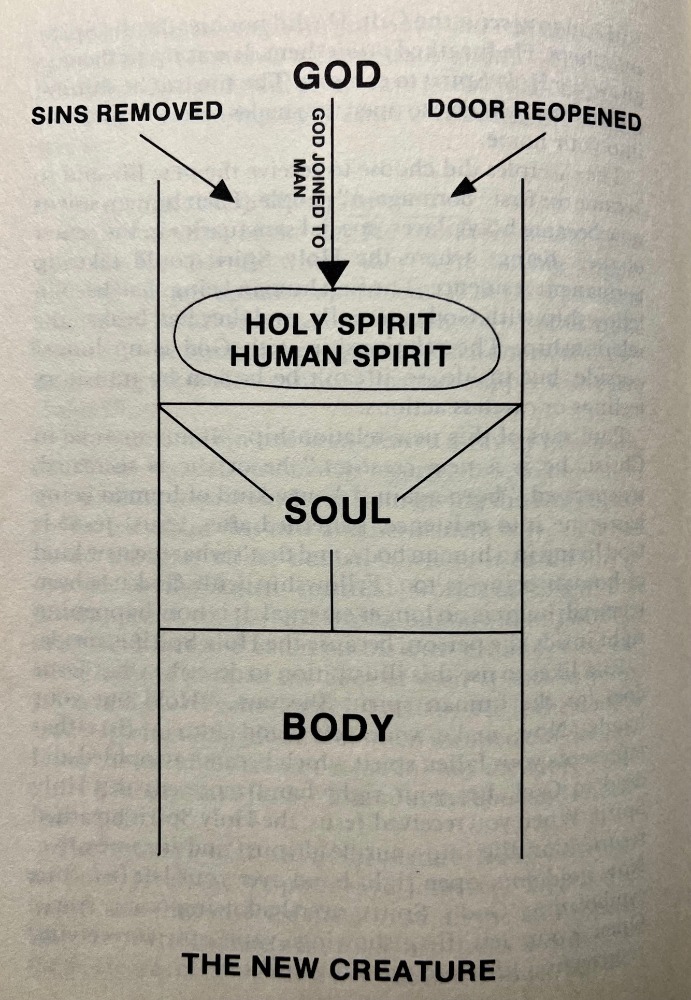
The article then clarifies that trichotomy is not requiring soul and spirit to be different in substance (both are spiritual in the sense of being immaterial). So there is a sense in which man is dichotomous, with two separable elements, material and immaterial. However, the results of this biblical study show that soul and spirit are nevertheless ontologically distinct (480-82).
The article then connects the conclusion of these word studies and expository observations with doctrinal implications including the nature of creation, the fall, regeneration, and future resurrection (483-88).
Having presented this study, the article concludes with seven propositions that support man a spirit, soul and body (489-90).
A PDF of the full article is available here and deserves to be read by students of biblical psychology.
Dr. S.H. Kellogg, Trichotomy: Biblical Study in Bibliotheca Sacra 1890-07: Vol 47, iss. 187. pp 461-89. Accessed at https://archive.org/details/sim_the-bibliotheca-sacra_1890-07_47_187
[1] https://dcbasia.org/biography/kellogg-samuel-h
[2] The Platonists’ trichotomy was different; they [wrongly] believed that the mind (GK nous) in man was a part of the eternal self-existent God, or Logos (p. 470).
For a discussion of the Christology of Apollinaris, why it was condemned, and Augustine’s influence on the history of doctrine, see Man as Spirit, Soul and Body, chapter 5.
JBW

 Biblical Psychology