Unknown's avatar

About jbwoodward

John serves as Director of Counseling and Training for Grace Fellowship International. His main article archive is GraceNotebook.com

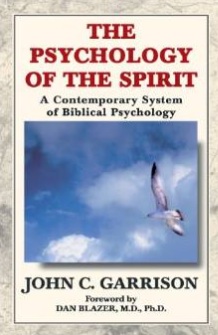
The Psychology of the Spirit

Psych_SpiritJohn Garrison has published a book on biblical psychology that includes a body/soul/spirit perspective on the nature of man. It is available at the Amazon.com .

The volume includes a Foreword by Dan Blazer, a Christian Psychiatrist and Professor at Duke University.

The book is published by Xlibris Corporation and is now being updating and revised.  The new edition will be published by West Bow Press, a division of the Bible publisher Thomas Nelson.

A System of Biblical Psychology, by Franz Delitzsch

A System of Biblical Psychology, by Franz Delitzsch

Is in the public domain and made available at Bible Study Tools:
http://www.biblestudytools.com/classics/delitzsch-system-of-biblical-psychology/

In the chapter, The Regeneration, the author discusses 1 Corinthians 15:45 and related passages:

“For the soul was first of all the personal link of human nature; but the spirit was to become the personal power, i.e. the ruling, glorifying, and, so to speak, personifying power, of the entire personality. This object remained unattained; for the spirit—instead of proving itself ^wottoiovv, i.e. an all-pervading power of life, in ever increasing energy and with ever extending result—fell under the bondage of the flesh in such a way, that, although its God-resembling substance continues still, its God-resembling life is quenched. Man, from the good, but still in some measure undetermined, position of a self-living ^frv^rj fwtra (undetermined, in that it still wanted the confirmation and establishment of man’s own proper self-determination), instead of becoming m/evfiaTiKo<;, ue. directed on all sides by the spirit that lives and moves in the God who was its source, became -v/ru^i/io? and aapKiKo<;, i.e. altogether determined by His -^v^r), escaped from the spirit, and identified in a mode adversely determined, and by the aap}; fallen away from the spirit, and therefore, from a material nature, become a gross materialistic nature. The spirit is not what it was intended to be—the personal might of the entire life; but only still a consciousness of the individual life held together by the soul. The Psyche [soul] has usurped the right of the Pneuma [spirit]; in it, and not in the Pneuma, the individual life of the person has its united form of existence.1 But in Christ a new beginning is established, which bears in itself the most infallible guarantee of completion; and on account of the superabundant intensity of its power of propagation, suggests the hope of a renewal of the whole of humanity. The spirit of the first Adam had God’s presence, as it were, as a productive root, from which it could be nourished and strengthened, but from which also it might be disjoined. In the second Adam, on the other hand, the Logos united Himself inseparably with the human spirit, in such a w7ay, that in proportion as the threefold human life is developed out of its embryonic elements, the Logos also, which has made itself the personal ground of this life, proves itself more and more to be the divine personifying might of the same.”

-“The New Life of the Spirit”

http://www.biblestudytools.com/classics/delitzsch-system-of-biblical-psychology/

Spiritual Life

An excerpt from Evan Hopkins – The Law of Liberty in the Spiritual Life (ch. 3)

“That which is born of the Spirit is spirit.” – John iii. 6.

“But the water that I shall give him will become in him a fountain of water springing up into everlasting life.” – John iv. 14.

A REMARKABLE brick from the wall of Babylon bears the inscription of one of its mighty kings. In the centre of the inscription is a footprint of one of the dogs which wandered about the crowded city. It was the custom to imprint the royal mark upon the bricks used for public works. While this particular brick was lying in its plastic state to dry, a vagrant dog had accidentally trodden upon it. The king’s inscription is entirely illegible, while the footprint of the dog is perfectly distinct. The name of the mighty ruler of Babylon is unknown. The footprint of the dog has decidedly the advantage over the inscription of the king (Norton).

May we not see a picture here of man’s present condition? Created originally “in the image and after the likeness of God,” man, as he is now by nature, no longer reflects the moral beauty and perfection of the Divine character. While in one part of his nature – the soul – God’s image is defaced, in another part the spirit – it is altogether obliterated. The footprint of the Evil One is distinctly visible.

And yet we would not say that there are no traces of the original inscription. The Scriptures recognize such outlines, faint though they be, even among the heathen (Rom. ii. 14, 15). And yet while this is true, the word of God speaks of man as wholly corrupt, and needing a change, so complete and thorough, that it is called a “new creation.” He “must be born again.”

Man as originally created, consisted of spirit, soul, and body. We read, “The Lord God formed man of the dust of the ground, and breathed into his nostrils the breath of life; and man became a living soul” (Gen. ii. 7).

In order of thought, we have first the construction of the body. Man was made of the dust of the ground, and fashioned by the hand of God, as the potter fashions the clay. Then, into that body thus formed, God breathed “the breath of life.” And yet “the formation of man from the dust, and the breathing of the breath of life, must not be understood in a mechanical sense, as if God first of all constructed a human figure from the dust, and then, by breathing His breath of life into the clod of earth which He had shaped into the form of man, made it into a living being. . . . By an act of Divine omnipotence man arose from the dust; and in the same moment in which the dust, by virtue of creative omnipotence, shaped itself into a human form, it was pervaded by the Divine breath of life, and created a living being, so that we cannot say the body was earlier than the soul” (Delitzsch).

“Man became a living soul.” Though the same term is employed to designate the lower animals (Gen. i. 20, 21), “It does not necessarily imply that the basis of the life-principle in man and the inferior animals is the same. The distinction between the two appears from the difference in the mode of their creations. The beasts arose as the Almighty fiat completed beings every one a living soul. Man received his life from a distinct act of Divine in-breathing – a communication from the whole Personality of the Godhead. In effect, man was thereby constituted a living soul like the lower animals; but in him the life-principle conferred a <i>personality which was wanting in them” (Delitzsch).

Man not only received that part which we term soul, but that part termed spirit. He was not a mere individual creature, like the lower animals: he became a <i>person. That personality was the meeting point of the two natures, the animal and the spiritual. He consisted, therefore, of the three parts – spirit, soul, and body. Body and spirit uniting in the personal soul is the true idea of man as he came forth from the hand of God.

But what is man’s present constitution since the Fall? The Scriptures declare that he is now by nature “dead in trespasses and sin.” That is, so far as his spirit-nature is concerned, towards God he is dead. Not, we would observe, that his spirit-nature has ceased to exist. Not that, since the Fall, he has become body and soul, instead of body, soul, and spirit. For while he is dead towards God, he is not dead towards sin (Jude 19. “Sensual, having not the Spirit.” Even though we may hesitate to accept the interpretation, with De Wette and others, that the reference here is to the Holy Spirit, this passage cannot be pressed as proving that fallen man has ceased to possess a spirit-nature. Alford observes on this text: “These men have not indeed ceased to have spirit (pneuma), as part of their own tripartite nature; but they have ceased to possess it in any worthy sense: it is degraded beneath and under the power of the soul (psuche), the personal life, so as to have no real vitality of its own.” The pneuma is that which essentially distinguishes man from an animal, a breath from (out of) God, the noblest part of our nature; but as, in the case of all natural men, it lies concealed, since the Fall, in carnal and animal life, it may be so effectually sunk and buried under the flesh by continual sins, as if it were no longer extant” (Lange, Commentary on St. Jude. See Appendix, Note C). All capacity to understand the things of the Spirit is gone. The Fall has robbed him of the ability to hold communion with God.

And yet fallen man is capable of every kind of sin – not only of sin that pertains to the body and soul, but of sin that pertains to the spirit. He is capable of “spiritual wickedness.” He must therefore still possess a spirit-nature.

Satan needs the spirit of a man to produce the highest development of human evil.

When therefore it is said that man is dead spiritually, we understand by this that he is utterly incapable of intercourse with God. In this condition of death he is incapable of attaining the true ideal of human nature.

“What, then, is man in this state? How do the Scriptures designate him? He is described as “natural.” “The natural man does not receive the things of the Spirit of God” (1 Cor. ii. 14). He is soulish. This is the highest condition he is capable of attaining. He is one whose highest nature is the soul. The natural man is the soulish man. He is governed by his soul. He cannot rise higher, but he may sink lower. He may become devilish. His spirit-nature may become satanically possessed.

The natural man is not necessarily one who is the slave of his carnal appetites. He may be a moralist of the highest type. He may be a giant in intellect, as some of the Greek philosophers were, having all that can be derived from the first Adam: one endowed with a rational soul, and who has the use of all his rational faculties, and yet destitute of the capacity of understanding the things of the Spirit of God, or of holding communion with Him.

The reason for this incapacity is clear. The Scripture furnishes the answer: “Because they are spiritually discerned.” From the very nature of the case it must be so. It is not that the natural man <i>will not “know” the things of the Spirit – he <i>cannot know them.

To put the matter clearly, we may say there are three great spheres – of sense, of reason, and of spirit.

There are the things which come within the sphere of sense. The lower animals are endowed with the faculties of seeing and knowing these things in common with man. With us they can touch and taste and see. These powers are possessed by the brute creation as well as by ourselves. We convince ourselves of the substantial reality of the material world by these faculties of sense.

Then there are the things which come within the sphere of reason. Now we rise into a higher domain – into a region which is beyond the reach of the lower animals. Man alone has the power of drawing deductions, forming conclusions, and grasping abstract notions. Man alone has the sense of moral obligation.

And lastly, there are the things which come within the sphere of spirit. And these the Scripture declares are beyond the reach of the “natural man” – the psychical or soulish man. These belong to the spirit-life, and are grasped by faith.

You may put a telescope into the hands of a man who is blind, and bid him look at some distant star, or on some lovely landscape. He tells you he sees nothing. Well, his witness is true. So the Agnostic affirms of all supernatural religion, that he knows it not. His witness also is true. But if the blind man goes further, and asserts that because he sees nothing there is <i>nothing to see, his assertion is untrue, and his witness is worthless, because he speaks beyond the range of his capacity.

Such is the value of the natural man’s opinion when he declares his mind on spiritual things.

But the natural man may become spiritual. The spiritually blind may be restored to sight. The Agnostic who “knows not” may be brought to see and understand and know.

The life of the spirit-nature may be restored. This is brought about by the operation of the Spirit of God. But how? What is the nature of the process?

“Not by the growth of the soul-principle, the development of the natural man. No one passes from the natural sphere into the spiritual by virtue of powers lying dormant in the soul. It is not by the culture of the natural faculties, nor is it by any supposed uncovering of the spirit-nature, as if it only lay buried underneath.

The spirit is quickened by a direct communication of life from above.

“That which is born of the flesh is flesh, and that which is born of the Spirit is spirit.” “You must be born from above.”

So to be alive unto God is to have received this Divine quickening. “Now we have received, not the spirit of the world, but the Spirit which is of God” (1 Cor. ii. 12).

It is in that spirit-nature the Holy Spirit dwells. Until that nature is quickened, there can be no spiritual nourishment, no spiritual instruction or spiritual training. For what is there to feed? what is there to instruct? what is there to develop?

But Divine life having been imparted, that which follows is the growth and development of the spirit-principle; and this involves the progressive transformation of the character.
The Scarlet Thread

When I visited Australia years ago I caught a glimpse of a church that has impacted the world through it’s praise and worship. Hillsong also produces creative, contemporary videos that testify of God’s saving grace. This 30 minute film compares the spread of the Gospel to the skillful weaving of a tapestry. Several “chapters” feature candid testimonies and a kaleidoscope of cultural scenes that form a fabric in need of the scarlet thread of Christ’s redemption.
-JBW

Hillsong Live Presents: The Scarlet Thread from hillsong-live on GodTube.

What is Man?

British pastor and author wrote with keen insight about this theme. See his ebook…

“Many who read this will be familiar with the position of psychology, and it is just here that we find that point which makes all the difference between the natural, which keeps God out, and the spiritual, which gives Him His full place. For here we find that the scriptural description of man runs entirely counter to the conclusions of ‘scientific’ psychology. We have observed that the psychologist will not allow the threefold description of man as spirit, soul and body, but only soul—or mind—and body. But still, the psychologist has to confess to the existence of a third element. He recognizes it, finds his chief interest and occupation with it, builds up a whole system of experimentation around it, and often borders on calling it by its right name. But to do so would be to give too much away; and Satan, who has the mind of the natural man well on leash, sees to it that in this, as in other matters, just the word is not used. The psychologist, therefore, recoils and calls the extra factor ‘the subconscious mind’, or ‘the subjective mind’, or ‘the subliminal self’, or ‘the secondary personality’, etc.”

Continue reading: http://austin-sparks.net/english/books/001339.html

Three Faculties of the Human Spirit

Since Watchman Nee’s writings convey the trichotomy of man, this is likely the majority view of the fast-growing unregistered church in China. Nee’s associate, Witness Lee, described the faculties of the human spirit (what ontologically distinguishes humans from animals) in this way:

THE THREE PARTS OF THE SPIRIT—CONSCIENCE, FELLOWSHIP, AND INTUITION

Just as our body has many parts, so does our spirit and our soul. Our spirit is composed of three: conscience, fellowship, and intuition. The conscience is for us to discern right from wrong, to justify or to condemn. Romans 9:1 compared with Romans 8:16 proves that the conscience is a part of our spirit. Fellowship is for us to contact God and to commune with God. This is shown in John 4:24 and Romans 1:9. Intuition means to have a direct sense or feeling in our spirit, regardless of reason or circumstance. First Corinthians 2:11 indicates that our spirit can know what our soul cannot. Our soul knows by reason or by circumstance, but our spirit can perceive without these. This is intuition, the direct sense in our spirit.

The Parts of Man, chapter 1, http://www.ministrybooks.org/books.cfm?xid=B3ZPZHX6THXHY

Rather than using the term “parts,” I recommend the term “faculties.” This clarifies that man has only three distinguish- able “parts,” yet each part has faculties. The spirit is the base of intuition, conscience and fellowship (communion), whereas the soul is the seat of mind, will, and emotions.

Lee’s approach refers to individual verses to substantiate the spirit/soul distinction. These cited references do illustrate and confirm these aspects of the human spirit. However, a primary principle to classify these higher faculties as related to the human spirit is that they are higher in functioning and capacity than any animal.

The Art of Biblical Counseling

Under the heading, Consideration of a Tripartite Model of The Human:

There is more to the human mind than the spiritual dimension [which the author had been addressing]. Another dimension can be called the psyche (Doran, 1977, 1981, 1990  Lonergan, 1957, p. 456), which includes emotions, imagery, and memories whic cohere to form personality structures (Helminiak, 1992, 1996)… Differentiation of the psyche and the spirit within the human mind refines the standard model of the human, replacing the bipartite model–body and mind–with a tripartite model–organism (body), psyche, and spirit (Frankl, 1969/1988; Institute of Logotherapy, 1979; Lonergan, 1957, Vande Kempe, 1982). Although the term psych has a wide range of meanings, in this article psyche is a stabilizing dimension of the human mind. Its inclination is to sustain a comfortable homeostasis (Helminiak, 1996). In contrast, the human spirit is dynamic, open-ended, ever unfolding, ever transcending. It fosters transformation, and its ideal goal is to attain, through continued adjustment, in an ultimate coincidence of subjectivity and objectivity, unity with all that is.

The Art of Biblical Counseling: A Comprehensive Guide on How to Counsel Using Biblical Principles (2008: Xlibris Corporation), p. 491 (Kindle edition), by Forshaye Winbush, PhD.

Although Dr. Winbush documents this model of man through secular sources, his description of the trichotomous model of man in a Christian counseling context is welcome.

Relevance in Sanctification

Here is a quote from Jessie Penn-Lewis (The Centrality of the Cross, ch. 5). The Lord used her writing in the era of the Welch revival and beyond.

In Dr. Andrew Murray’s Spirit of Christ, he gives in the Appendix a very clear explanation of the dividing of soul and spirit which has to be done in the believer. He explains how man fell from the ‘spirit’ dominating his whole being, into the soul, and then again how the soul sank down into the flesh, so that at last God said of man “He is become flesh.” He descended from spirit to soul, and from soul to ‘flesh’. The spirit of man, says Dr. Murray, is that in us which is capable of knowing God-spirit-consciousness. The soul is the seat of the self-consciousness, and the body the seat of sense consciousness. An understanding of simple Bible psychology is necessary for any apprehension of the full life of victory through the atoning work of our Lord Jesus Christ. There is more to be dealt with in us than what we call ‘sin’, and more than ‘sin’ which prevents our full knowledge of God.

Scofield Reference Notes 1917

1 Thess.5:23  “And the very God of peace sanctify you wholly; and I pray God your whole spirit and soul and body be preserved blameless unto the coming of our Lord Jesus Christ.”

“whole spirit, and soul, and body”

Man a trinity. That the human soul and spirit are not identical is proved by the facts that they are divisible. Hebrews 4:12 and that soul and spirit are sharply distinguished in the burial and resurrection of the body. It is sown a natural body (soma psuchikon= “soul- body”), it is raised a spiritual body (soma pneumatikon) 1 Corinthians 15:44 . To assert, therefore, that there is no difference between soul and spirit is to assert that there is no difference between the mortal body and the resurrection body. In Scripture use, the distinction between spirit and soul may be traced. Briefly, that distinction is that the spirit is that part of man which “knows” 1 Corinthians 2:11, his mind; the soul is the seat of the affections, desires, and so of the emotions, and of the active will, the self. “My soul is exceeding sorrowful” Matthew 26:38, see also ; Matthew 11:29 ; John 12:27 . The word transliterated “soul” in the O.T. (nephesh) is the exact equivalent of the N.T. word for soul ( (Greek – eujyucevw ), and the use of “soul” in the O).T. is identical with the use of that word in the N.T. (see, e.g.) ; Deuteronomy 6:5 ; 14:26 ; 1 Samuel 18:1 ; 1 Samuel 20:4 1 Samuel 20:17 ; Job 7:11 Job 7:15 ; 14:22 ; Psalms 42:6 ; 84:2 . The N.T. word for spirit (pneuma) like the O.T. (ruach), is trans. “air”, “breath”, “wind,” but predominantly “spirit,” whether of God (e.g.) ; Genesis 1:2 ; Matthew 3:16 or of man ; Genesis 41:8 ; 1 Corinthians 5:5 . Because man is “spirit” he is capable of God-consciousness, and of communication with God ; Job 32:8 ; Psalms 18:28 ; Proverbs 20:27 because he is “soul” he has self- consciousness ; Psalms 13:2 ; Psalms 42:5 Psalms 42:6 Psalms 42:11 because he is “body” he has, through his senses, world consciousness.

http://www.biblestudytools.com/