Unknown's avatar

About jbwoodward

John serves as Director of Counseling and Training for Grace Fellowship International. His main article archive is GraceNotebook.com

What About When “Soul” and “Spirit” are Used Interchangeably?

Synechdoche is a figure of speech that occurs often in literature, including the Holy Bible. It is the convention of mentioning a part when the whole is in view, and visa versa. This explains how a part (such as the human spirit) can sometimes be used to include the soul, and sometimes body for soul. For example: “And it shall be that every soul who will not hear that Prophet shall be utterly destroyed from among the people” (Acts 3:23). That punishment obviously would include the material aspect of man, not just his soul. Thus, some interchangeable use of terms does not disprove that the human soul and spirit are ontologically distinct.

Consider how the persons of the Trinity are sometimes referred to by the names of the Others.

God is triune; He is three persons, yet one God.

“Yet for us there is one God, the Father, of whom are all things, and we for Him; and one Lord Jesus Christ, through whom are all things, and through whom we live.” “One God and Father of all, who is above all, and through all, and in you all.” “For there is one God and one Mediator between God and men, the Man Christ Jesus” (1 Cor. 8:6; Eph. 4:6; 1 Tim. 2:5).

The Holy Spirit is referred to as the Spirit of His Son. “And because you are sons, God has sent forth the Spirit of His Son into your hearts…” (Gal. 4:6).

The Holy Spirit is referred to as the Spirit of Christ.  “Searching what, or what manner of time, the Spirit of Christ who was in them was indicating when He testified beforehand the sufferings of Christ and the glories that would follow” (1 Pet. 1:11).

The Son of God, Christ, is distinct person from the Holy Spirit (Matt. 3:16,17). But note how, since God is tri-une, the “Spirit” is used interchangeably with “the Spirit of His Son” as in the next verse in 1 Peter: “To them it was revealed that, not to themselves, but to us they were ministering the things which now have been reported to you through those who have preached the gospel to you by the Holy Spirit sent from heaven–things which angels desire to look into” (1 Pet. 1:12).

Isaiah uses the title “Everlasting Father” of Christ. “For unto us a Child is born, Unto us a Son is given; And the government will be upon His shoulder. And His name will be called Wonderful, Counselor, Mighty God, Everlasting Father, Prince of Peace” (Isaiah 9:6).

Jesus identifies Himself closely with the Father. “Jesus said to him, ‘Have I been with you so long, and yet you have not known Me, Philip? He who has seen Me has seen the Father; so how can you say, ‘Show us the Father’?” (John 14:9).

Yet, God the Son and God the Father are distinct persons in the Godhead: “Then Jesus answered and said to them, ‘Most assuredly, I say to you, the Son can do nothing of Himself, but what He sees the Father do; for whatever He does, the Son also does in like manner. For the Father loves the Son, and shows Him all things that He Himself does; and He will show Him greater works than these, that you may marvel. For as the Father raises the dead and gives life to them, even so the Son gives life to whom He will. For the Father judges no one, but has committed all judgment to the Son, that all should honor the Son just as they honor the Father. He who does not honor the Son does not honor the Father who sent Him” (John 5:19-23).

However, note how the Son and the Father are spiritually united: “At that day you will know that I am in My Father, and you in Me, and I in you” (John 14:20).  “I and My Father are one” (John 10:30).

The Holy Spirit is God (Acts 5:4) yet is distinct from the Father who is also recognized as God (1 Cor. 1:3). “And I will pray the Father, and He will give you another Helper, that He may abide with you forever…But the Helper, the Holy Spirit, whom the Father will send in My name, He will teach you all things, and bring to your remembrance all things that I said to you” (John 14:16,26).

Therefore, if terms can be used interchangeable of God the Father, Son, and Spirit without contradicting the doctrine of God’s tri-unity, even so some interchangeable usage of soul and spirit need not contradict the tri-unity of man (1 Thess. 5:23).

Geisler on Holistic Trichotomy

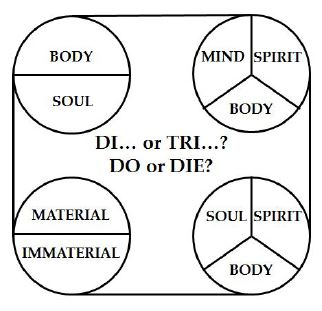
Dr. Norman Geisler presents the biblical doctrine of man in his extensive Systematic Theology. His description of the model of man is compatible with–or identical to–holistic trichotomy: one in personhood with two separable parts, yet three distinguishable parts (aspects).

“Each individual human being is a unity of soul and body, having a spiritual dimension and a physical dimension. Each partakes of the immaterial as well as the material, the angelic as well as the animal. As such, human beings are unique: each is a psychodynamic unity, a blend of mind and matter.

…At death, ‘The dust returns to the ground it came from, and the spirit returns to God who gave it’ (Eccl. 12:7)…Paul speaks of ‘spirit, soul, and body’ forming an individual ‘wholly’ (1 Thess. 5:23); that is, these three aspects constitute one person.

However, within this basic unity is a tri-dimensionality, because a human being is self-conscious, world-conscious, and God-conscious. He can look inward, outward, and upward. But he is, nonetheless, one person, with one individual human nature.

Within the unity of human nature, there is also a basic duality. The unity of soul and body is not an identity of the two; the union is not an indissolvable one. As death ‘we are…away from the body and at home with the Lord'(2 Cor. 5:8)…The separation is only temporary: They await their reunion at the resurrection, when they will be brought back together permanently (1 Thess. 4:13-17).

Systematic Theology (One Volume Edition, pp636, 37 Minneapolis: Bethany House, 2002).

Physical Aspects of Psychological Health

One of the drawbacks of the monistic view of man is that there is not adequate attention given to one’s distinct parts. The apostles Paul and Peter referred tp their physical body as a distinct and separable part of them–a tent (2 Cor. 5:1; 2 Pet.1:13,14). Some ministries specialize in the physical aspect of man but from a biblical perspective. However, they may totally miss the spiritual solution(s). The complete provision of God will include spiritual, soulical, and physical guidance. Here is a re-post from a health ministry about the role of nutrition:

The Truth About Depression (& the Natural Solution)

When the last leaves of autumn drop and the cold chill of winter sets in, many people start to feel a sense of melancholy. Combine that with fewer hours of sunlight and less time with nature and that sad mood might deepen into a feeling of depression that’s persistent and pervasive. Even the months after Christmas and the New Year affect many people, as their mood dies down with the holiday spirit. Although the “winter blues” are common, it’s estimated that around 19 million Americans suffer from depression at any point during the year.

Depressed individuals, in addition to their own suffering, find that their families, friends, colleagues, community and church members all become affected too. Their productivity deteriorates along with their social lives. But there is hope. The path to wellness is understanding what depression is and how to fight it using a safe, natural and sustainable approach.

read more

Alpha Series

[This workbook applies an explicit spirit/soul/body model of man to discipleship and counseling.]

What is the Alpha Series? Is it a program? Is it a religion? The simplest answer is that the Alpha Series explains the gospel of Jesus Christ in a way that ordinary people can understand and apply it to themselves. What makes the Alpha Series effective as a counseling model, discipleship course, training curriculum, or recovery tool is the fact that it is a practical application of the gospel which is “the power of God unto salvation to everyone that believeth…” (Romans 1: 16).

People are hungry for the gospel of grace but turned off by religion. Because the Alpha Series is not religious but biblical in nature most people will be receptive to the teaching regardless of their background and life experience. Religion is man’s attempt to manipulate deity by what he says or does. Biblical Christianity is a personal relationship with God based on believing in what He has done for us in Christ that we could not do for ourselves. The Alpha Series is simply an explanation of what the Bible says that God has done to make us worthy as persons. Whenever the gospel is taught it is the power of God that changes the lives of all who believe it.

The Alpha Series is constructed in three main parts. Part one describes the manner in which personal and relational problems develop from the core emotions of fear of rejection and fear of failure due to low self esteem. The insight gained in understanding how problems develop sets the stage for the application of the gospel of Jesus Christ as the only workable solution. Part two provides a biblical foundation on which to build a healthy self-image based entirely upon our new identity in Christ. The good news of our union with Christ is applied to the daily task of allowing ourselves to be transformed by the renewing of the mind. Part three carries the gospel of our new identity in Christ to the logical end of ministering to the needs of others. Having been assured of our personal security in all that God has done for us in Christ, we have the confidence and power to concern ourselves with helping others. True recovery is not complete until we learn to minister rather than manipulate. For additional information on the Alpha Series and its application visit the Alpha Ministries website at www.alphaministries.org.

The Secret of Guidance

F.B. Meyer observed:

He [Christ] desires to be in us as His Father was in Him, so that the outgoings of our life may be channels through which He, hidden within, may pour Himself forth upon men.

It is not generally recognized. It is not; though that does not disprove it. We fail to recognize many things in ourselves and in nature around, which are nevertheless true. But there is a reason why many whose [spiritual] natures are certainly the temple of Christ, remain ignorant of the presence of the wonderful Tenant that sojourns within. He dwells so deep. Below the life of the body, which is as the curtain of the tent; below the life of the soul, where thought and feeling, judgment and imagination, hope and love, go to and fro, ministering as white-stoled priests in the holy place; below the play of light and shade, resolution and will, memory and hope, the perpetual ebb and flow of the tides of self consciousness, there, through the Holy Spirit, Christ dwells, as of old the Shechinah dwelt in the Most Holy Place, closely shrouded from the view of man [1 Cor. 6:19].

It is comparatively seldom that we go into these deeper departments of our being. We are content to live the superficial life of sense. We eat, we drink, we sleep. We give ourselves to enjoy the lust of the flesh, the lust of the eyes, and the pride of life. We fulfill the desires of the flesh and of the mind. Or we abandon ourselves to the pursuit of knowledge and culture, of science and art. We make short incursions into the realm of morals, that sense of right and wrong which is part of the make up of men. But we have too slight an acquaintance with the deeper and more mysterious chamber of the spirit. Now this is why the majority of believers are so insensible of their Divine and wonderful Resident, who makes the regenerated spirit His abode [1 Cor. 6:17].

(excerpt: The Secret of Guidance ch. 3 (Fleming H, Revell: 1896)
http://www.ccel.org/ccel/meyer/guidance.txt emphasis added)

Christian Paths to Health and Wellness

An example of a college text book that focuses on physical health from a biblical worldview is this one. The authors set health in the context of redemption history and address the body in light of psychological (soul), and spiritual (spirit) dimensions.

Paths1“Christian Paths to Health and Wellness, Second Edition, offers a unique, faith-based perspective on the pursuit of wellness for body, mind, and spirit. Written for undergraduate students attending Christian universities, this updated edition also serves as a reference for anyone seeking God-pleasing guidance to make positive life changes.”

Wealth, Walk, and Warfare

In her classic book on the epistle to the Ephesians, The Wealth, Walk, and Warfare of the Christian, Ruth Paxson wrote

Eph. 1:3. “With all spiritual blessings.”

The word “spiritual” designates the character of the blessings bestowed. A saint is one who has left the sphere of the natural and has come into the sphere of the spiritual. Henceforth his paramount needs are spiritual. He has become the possessor of a heaven-born nature, so he must have heaven-sent supplies to nourish and develop it. The saint has had implanted within him the eternal life of the Holy One, but he is traveling through an ungodly world, so moment by moment he needs life from above that he may live holily. Living in a non-spiritual world, he needs a spiritual atmosphere in which to breathe; spiritual food to eat; spiritual garments to wear; spiritual companions with whom to fellowship, spiritual exercise to keep fit and strong; spiritual strength to endure suffering and affliction; spiritual weapons with which to war.

The human personality consists of spirit, soul and body, as God has shown in I Thessalonians 5:23. In quoting man usually says “body, soul and spirit.” God’s order cannot be reversed. He always begins with the inner man, and works out to the outer man. To Him the spirit is paramount and is always put first. So God’s concern is for a daily spiritual renewal which will cause the saint to grow up into Christ in all things, working ever toward the goal of a greater perfection. Life in Christ commences with a spiritual birth; continues through spiritual growth; and consummates at His coming in spiritual perfection. (emphasis added)

from chapter 3: “The Wealth Designated

The Psychology of the Spirit

Psych_SpiritJohn Garrison has published a book on biblical psychology that includes a body/soul/spirit perspective on the nature of man. It is available at the Amazon.com .

The volume includes a Foreword by Dan Blazer, a Christian Psychiatrist and Professor at Duke University.

The book is published by Xlibris Corporation and is now being updating and revised.  The new edition will be published by West Bow Press, a division of the Bible publisher Thomas Nelson.

A System of Biblical Psychology, by Franz Delitzsch

A System of Biblical Psychology, by Franz Delitzsch

Is in the public domain and made available at Bible Study Tools:
http://www.biblestudytools.com/classics/delitzsch-system-of-biblical-psychology/

In the chapter, The Regeneration, the author discusses 1 Corinthians 15:45 and related passages:

“For the soul was first of all the personal link of human nature; but the spirit was to become the personal power, i.e. the ruling, glorifying, and, so to speak, personifying power, of the entire personality. This object remained unattained; for the spirit—instead of proving itself ^wottoiovv, i.e. an all-pervading power of life, in ever increasing energy and with ever extending result—fell under the bondage of the flesh in such a way, that, although its God-resembling substance continues still, its God-resembling life is quenched. Man, from the good, but still in some measure undetermined, position of a self-living ^frv^rj fwtra (undetermined, in that it still wanted the confirmation and establishment of man’s own proper self-determination), instead of becoming m/evfiaTiKo<;, ue. directed on all sides by the spirit that lives and moves in the God who was its source, became -v/ru^i/io? and aapKiKo<;, i.e. altogether determined by His -^v^r), escaped from the spirit, and identified in a mode adversely determined, and by the aap}; fallen away from the spirit, and therefore, from a material nature, become a gross materialistic nature. The spirit is not what it was intended to be—the personal might of the entire life; but only still a consciousness of the individual life held together by the soul. The Psyche [soul] has usurped the right of the Pneuma [spirit]; in it, and not in the Pneuma, the individual life of the person has its united form of existence.1 But in Christ a new beginning is established, which bears in itself the most infallible guarantee of completion; and on account of the superabundant intensity of its power of propagation, suggests the hope of a renewal of the whole of humanity. The spirit of the first Adam had God’s presence, as it were, as a productive root, from which it could be nourished and strengthened, but from which also it might be disjoined. In the second Adam, on the other hand, the Logos united Himself inseparably with the human spirit, in such a w7ay, that in proportion as the threefold human life is developed out of its embryonic elements, the Logos also, which has made itself the personal ground of this life, proves itself more and more to be the divine personifying might of the same.”

-“The New Life of the Spirit”

http://www.biblestudytools.com/classics/delitzsch-system-of-biblical-psychology/