Our Spiritual Purpose

“With a perfect heart . . . to make David king” —1 Chronicles 12:38

What is the supreme purpose of our lives? The Israelites were of one heart to make David king. Is this our purpose, to prepare the Bride, to prepare the world, to prepare His way?

Does this objective dwarf and dim all other ambitions, all other cares? Does it fill and satisfy every capacity, every power, every desire? Does it absorb every moment, every energy, every resource? Does it give direction and tone to every plan and work of life? Does it decide for us the education of our children, the investment of our means, the friendships and associations of life, the whole activity, interest and outlook of our beings? Are we in it, spirit, soul and body-all we are, all we do, all we hope for-of one heart to make Jesus King?

A. B. Simpson,
Days of Heaven on Earth (Dec. 5th reading)
http://cmalliance.org/devotions/simpson?mmdd=1205

Beside Still Waters

Grace Fellowship field staff member, Cherri Freeman, has written a significant and practical book on Christ-centered recovery–especially for mothers. The concluding three chapters address these issues through the facets of a mom’s body, soul, and spirit.


“When our children enter the bondage of addiction, it seems impossible to find any peace in our lives. Instead of still waters, we feel as if we are in the middle of a roaring river.

“The mother-child relationship is unique among all human relationships. Not only do our children share our bodies for nine months, they are a permanent part of our hearts. When they begin to make troubling choices, the desire to “fix” things often leads to the trap of codependency and enabling. We just want to make things better; however, that can be the worst thing that we can do for our child.

“Beside Still Waters: Finding Peace in the Midst of Your Child’s Addiction is a guide for mothers as they walk through the heart-wrenching times of their child’s addiction, dealing with topics such as denial, worry, enabling, guilt feelings,codependency, legal issues, signs of addiction, and more. Written from a Christ-centered, Bible-based perspective, it can be used by individuals or as the curriculum for a mothers’ support group.

“For families that are being torn apart by addiction, there is hope. Moms with kids in addiction need to know that they are not alone. Hope is found in Jesus Christ, and He desires to lead moms “Beside Still Waters” to whisper that message of hope to their aching hearts. Cherri Raws Freeman understands firsthand how addiction can destroy a family member. Growing up at America’s Keswick, she saw hundreds of lives that have been restored through victory in Jesus. She has also been on your journey as a mom. She has experienced hope and now wants to share that hope with you.
– Dr. Bill Welte
President/CEO America’s Keswick”
It can be ordered here: lovethemtolife.com

What About When “Soul” and “Spirit” are Used Interchangeably?

Synechdoche is a figure of speech that occurs often in literature, including the Holy Bible. It is the convention of mentioning a part when the whole is in view, and visa versa. This explains how a part (such as the human spirit) can sometimes be used to include the soul, and sometimes body for soul. For example: “And it shall be that every soul who will not hear that Prophet shall be utterly destroyed from among the people” (Acts 3:23). That punishment obviously would include the material aspect of man, not just his soul. Thus, some interchangeable use of terms does not disprove that the human soul and spirit are ontologically distinct.

Consider how the persons of the Trinity are sometimes referred to by the names of the Others.

God is triune; He is three persons, yet one God.

“Yet for us there is one God, the Father, of whom are all things, and we for Him; and one Lord Jesus Christ, through whom are all things, and through whom we live.” “One God and Father of all, who is above all, and through all, and in you all.” “For there is one God and one Mediator between God and men, the Man Christ Jesus” (1 Cor. 8:6; Eph. 4:6; 1 Tim. 2:5).

The Holy Spirit is referred to as the Spirit of His Son. “And because you are sons, God has sent forth the Spirit of His Son into your hearts…” (Gal. 4:6).

The Holy Spirit is referred to as the Spirit of Christ.  “Searching what, or what manner of time, the Spirit of Christ who was in them was indicating when He testified beforehand the sufferings of Christ and the glories that would follow” (1 Pet. 1:11).

The Son of God, Christ, is distinct person from the Holy Spirit (Matt. 3:16,17). But note how, since God is tri-une, the “Spirit” is used interchangeably with “the Spirit of His Son” as in the next verse in 1 Peter: “To them it was revealed that, not to themselves, but to us they were ministering the things which now have been reported to you through those who have preached the gospel to you by the Holy Spirit sent from heaven–things which angels desire to look into” (1 Pet. 1:12).

Isaiah uses the title “Everlasting Father” of Christ. “For unto us a Child is born, Unto us a Son is given; And the government will be upon His shoulder. And His name will be called Wonderful, Counselor, Mighty God, Everlasting Father, Prince of Peace” (Isaiah 9:6).

Jesus identifies Himself closely with the Father. “Jesus said to him, ‘Have I been with you so long, and yet you have not known Me, Philip? He who has seen Me has seen the Father; so how can you say, ‘Show us the Father’?” (John 14:9).

Yet, God the Son and God the Father are distinct persons in the Godhead: “Then Jesus answered and said to them, ‘Most assuredly, I say to you, the Son can do nothing of Himself, but what He sees the Father do; for whatever He does, the Son also does in like manner. For the Father loves the Son, and shows Him all things that He Himself does; and He will show Him greater works than these, that you may marvel. For as the Father raises the dead and gives life to them, even so the Son gives life to whom He will. For the Father judges no one, but has committed all judgment to the Son, that all should honor the Son just as they honor the Father. He who does not honor the Son does not honor the Father who sent Him” (John 5:19-23).

However, note how the Son and the Father are spiritually united: “At that day you will know that I am in My Father, and you in Me, and I in you” (John 14:20).  “I and My Father are one” (John 10:30).

The Holy Spirit is God (Acts 5:4) yet is distinct from the Father who is also recognized as God (1 Cor. 1:3). “And I will pray the Father, and He will give you another Helper, that He may abide with you forever…But the Helper, the Holy Spirit, whom the Father will send in My name, He will teach you all things, and bring to your remembrance all things that I said to you” (John 14:16,26).

Therefore, if terms can be used interchangeable of God the Father, Son, and Spirit without contradicting the doctrine of God’s tri-unity, even so some interchangeable usage of soul and spirit need not contradict the tri-unity of man (1 Thess. 5:23).

Geisler on Holistic Trichotomy

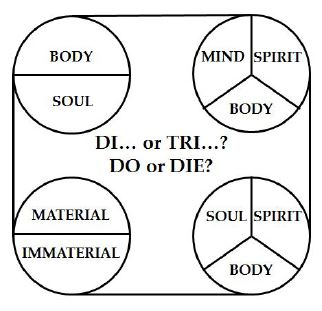
Dr. Norman Geisler presents the biblical doctrine of man in his extensive Systematic Theology. His description of the model of man is compatible with–or identical to–holistic trichotomy: one in personhood with two separable parts, yet three distinguishable parts (aspects).

“Each individual human being is a unity of soul and body, having a spiritual dimension and a physical dimension. Each partakes of the immaterial as well as the material, the angelic as well as the animal. As such, human beings are unique: each is a psychodynamic unity, a blend of mind and matter.

…At death, ‘The dust returns to the ground it came from, and the spirit returns to God who gave it’ (Eccl. 12:7)…Paul speaks of ‘spirit, soul, and body’ forming an individual ‘wholly’ (1 Thess. 5:23); that is, these three aspects constitute one person.

However, within this basic unity is a tri-dimensionality, because a human being is self-conscious, world-conscious, and God-conscious. He can look inward, outward, and upward. But he is, nonetheless, one person, with one individual human nature.

Within the unity of human nature, there is also a basic duality. The unity of soul and body is not an identity of the two; the union is not an indissolvable one. As death ‘we are…away from the body and at home with the Lord'(2 Cor. 5:8)…The separation is only temporary: They await their reunion at the resurrection, when they will be brought back together permanently (1 Thess. 4:13-17).

Systematic Theology (One Volume Edition, pp636, 37 Minneapolis: Bethany House, 2002).

Physical Aspects of Psychological Health

One of the drawbacks of the monistic view of man is that there is not adequate attention given to one’s distinct parts. The apostles Paul and Peter referred tp their physical body as a distinct and separable part of them–a tent (2 Cor. 5:1; 2 Pet.1:13,14). Some ministries specialize in the physical aspect of man but from a biblical perspective. However, they may totally miss the spiritual solution(s). The complete provision of God will include spiritual, soulical, and physical guidance. Here is a re-post from a health ministry about the role of nutrition:

The Truth About Depression (& the Natural Solution)

When the last leaves of autumn drop and the cold chill of winter sets in, many people start to feel a sense of melancholy. Combine that with fewer hours of sunlight and less time with nature and that sad mood might deepen into a feeling of depression that’s persistent and pervasive. Even the months after Christmas and the New Year affect many people, as their mood dies down with the holiday spirit. Although the “winter blues” are common, it’s estimated that around 19 million Americans suffer from depression at any point during the year.

Depressed individuals, in addition to their own suffering, find that their families, friends, colleagues, community and church members all become affected too. Their productivity deteriorates along with their social lives. But there is hope. The path to wellness is understanding what depression is and how to fight it using a safe, natural and sustainable approach.

read more

Alpha Series

[This workbook applies an explicit spirit/soul/body model of man to discipleship and counseling.]

What is the Alpha Series? Is it a program? Is it a religion? The simplest answer is that the Alpha Series explains the gospel of Jesus Christ in a way that ordinary people can understand and apply it to themselves. What makes the Alpha Series effective as a counseling model, discipleship course, training curriculum, or recovery tool is the fact that it is a practical application of the gospel which is “the power of God unto salvation to everyone that believeth…” (Romans 1: 16).

People are hungry for the gospel of grace but turned off by religion. Because the Alpha Series is not religious but biblical in nature most people will be receptive to the teaching regardless of their background and life experience. Religion is man’s attempt to manipulate deity by what he says or does. Biblical Christianity is a personal relationship with God based on believing in what He has done for us in Christ that we could not do for ourselves. The Alpha Series is simply an explanation of what the Bible says that God has done to make us worthy as persons. Whenever the gospel is taught it is the power of God that changes the lives of all who believe it.

The Alpha Series is constructed in three main parts. Part one describes the manner in which personal and relational problems develop from the core emotions of fear of rejection and fear of failure due to low self esteem. The insight gained in understanding how problems develop sets the stage for the application of the gospel of Jesus Christ as the only workable solution. Part two provides a biblical foundation on which to build a healthy self-image based entirely upon our new identity in Christ. The good news of our union with Christ is applied to the daily task of allowing ourselves to be transformed by the renewing of the mind. Part three carries the gospel of our new identity in Christ to the logical end of ministering to the needs of others. Having been assured of our personal security in all that God has done for us in Christ, we have the confidence and power to concern ourselves with helping others. True recovery is not complete until we learn to minister rather than manipulate. For additional information on the Alpha Series and its application visit the Alpha Ministries website at www.alphaministries.org.

A System of Biblical Psychology, by Franz Delitzsch

A System of Biblical Psychology, by Franz Delitzsch

Is in the public domain and made available at Bible Study Tools:
http://www.biblestudytools.com/classics/delitzsch-system-of-biblical-psychology/

In the chapter, The Regeneration, the author discusses 1 Corinthians 15:45 and related passages:

“For the soul was first of all the personal link of human nature; but the spirit was to become the personal power, i.e. the ruling, glorifying, and, so to speak, personifying power, of the entire personality. This object remained unattained; for the spirit—instead of proving itself ^wottoiovv, i.e. an all-pervading power of life, in ever increasing energy and with ever extending result—fell under the bondage of the flesh in such a way, that, although its God-resembling substance continues still, its God-resembling life is quenched. Man, from the good, but still in some measure undetermined, position of a self-living ^frv^rj fwtra (undetermined, in that it still wanted the confirmation and establishment of man’s own proper self-determination), instead of becoming m/evfiaTiKo<;, ue. directed on all sides by the spirit that lives and moves in the God who was its source, became -v/ru^i/io? and aapKiKo<;, i.e. altogether determined by His -^v^r), escaped from the spirit, and identified in a mode adversely determined, and by the aap}; fallen away from the spirit, and therefore, from a material nature, become a gross materialistic nature. The spirit is not what it was intended to be—the personal might of the entire life; but only still a consciousness of the individual life held together by the soul. The Psyche [soul] has usurped the right of the Pneuma [spirit]; in it, and not in the Pneuma, the individual life of the person has its united form of existence.1 But in Christ a new beginning is established, which bears in itself the most infallible guarantee of completion; and on account of the superabundant intensity of its power of propagation, suggests the hope of a renewal of the whole of humanity. The spirit of the first Adam had God’s presence, as it were, as a productive root, from which it could be nourished and strengthened, but from which also it might be disjoined. In the second Adam, on the other hand, the Logos united Himself inseparably with the human spirit, in such a w7ay, that in proportion as the threefold human life is developed out of its embryonic elements, the Logos also, which has made itself the personal ground of this life, proves itself more and more to be the divine personifying might of the same.”

-“The New Life of the Spirit”

http://www.biblestudytools.com/classics/delitzsch-system-of-biblical-psychology/

Spiritual Life

An excerpt from Evan Hopkins – The Law of Liberty in the Spiritual Life (ch. 3)

“That which is born of the Spirit is spirit.” – John iii. 6.

“But the water that I shall give him will become in him a fountain of water springing up into everlasting life.” – John iv. 14.

A REMARKABLE brick from the wall of Babylon bears the inscription of one of its mighty kings. In the centre of the inscription is a footprint of one of the dogs which wandered about the crowded city. It was the custom to imprint the royal mark upon the bricks used for public works. While this particular brick was lying in its plastic state to dry, a vagrant dog had accidentally trodden upon it. The king’s inscription is entirely illegible, while the footprint of the dog is perfectly distinct. The name of the mighty ruler of Babylon is unknown. The footprint of the dog has decidedly the advantage over the inscription of the king (Norton).

May we not see a picture here of man’s present condition? Created originally “in the image and after the likeness of God,” man, as he is now by nature, no longer reflects the moral beauty and perfection of the Divine character. While in one part of his nature – the soul – God’s image is defaced, in another part the spirit – it is altogether obliterated. The footprint of the Evil One is distinctly visible.

And yet we would not say that there are no traces of the original inscription. The Scriptures recognize such outlines, faint though they be, even among the heathen (Rom. ii. 14, 15). And yet while this is true, the word of God speaks of man as wholly corrupt, and needing a change, so complete and thorough, that it is called a “new creation.” He “must be born again.”

Man as originally created, consisted of spirit, soul, and body. We read, “The Lord God formed man of the dust of the ground, and breathed into his nostrils the breath of life; and man became a living soul” (Gen. ii. 7).

In order of thought, we have first the construction of the body. Man was made of the dust of the ground, and fashioned by the hand of God, as the potter fashions the clay. Then, into that body thus formed, God breathed “the breath of life.” And yet “the formation of man from the dust, and the breathing of the breath of life, must not be understood in a mechanical sense, as if God first of all constructed a human figure from the dust, and then, by breathing His breath of life into the clod of earth which He had shaped into the form of man, made it into a living being. . . . By an act of Divine omnipotence man arose from the dust; and in the same moment in which the dust, by virtue of creative omnipotence, shaped itself into a human form, it was pervaded by the Divine breath of life, and created a living being, so that we cannot say the body was earlier than the soul” (Delitzsch).

“Man became a living soul.” Though the same term is employed to designate the lower animals (Gen. i. 20, 21), “It does not necessarily imply that the basis of the life-principle in man and the inferior animals is the same. The distinction between the two appears from the difference in the mode of their creations. The beasts arose as the Almighty fiat completed beings every one a living soul. Man received his life from a distinct act of Divine in-breathing – a communication from the whole Personality of the Godhead. In effect, man was thereby constituted a living soul like the lower animals; but in him the life-principle conferred a <i>personality which was wanting in them” (Delitzsch).

Man not only received that part which we term soul, but that part termed spirit. He was not a mere individual creature, like the lower animals: he became a <i>person. That personality was the meeting point of the two natures, the animal and the spiritual. He consisted, therefore, of the three parts – spirit, soul, and body. Body and spirit uniting in the personal soul is the true idea of man as he came forth from the hand of God.

But what is man’s present constitution since the Fall? The Scriptures declare that he is now by nature “dead in trespasses and sin.” That is, so far as his spirit-nature is concerned, towards God he is dead. Not, we would observe, that his spirit-nature has ceased to exist. Not that, since the Fall, he has become body and soul, instead of body, soul, and spirit. For while he is dead towards God, he is not dead towards sin (Jude 19. “Sensual, having not the Spirit.” Even though we may hesitate to accept the interpretation, with De Wette and others, that the reference here is to the Holy Spirit, this passage cannot be pressed as proving that fallen man has ceased to possess a spirit-nature. Alford observes on this text: “These men have not indeed ceased to have spirit (pneuma), as part of their own tripartite nature; but they have ceased to possess it in any worthy sense: it is degraded beneath and under the power of the soul (psuche), the personal life, so as to have no real vitality of its own.” The pneuma is that which essentially distinguishes man from an animal, a breath from (out of) God, the noblest part of our nature; but as, in the case of all natural men, it lies concealed, since the Fall, in carnal and animal life, it may be so effectually sunk and buried under the flesh by continual sins, as if it were no longer extant” (Lange, Commentary on St. Jude. See Appendix, Note C). All capacity to understand the things of the Spirit is gone. The Fall has robbed him of the ability to hold communion with God.

And yet fallen man is capable of every kind of sin – not only of sin that pertains to the body and soul, but of sin that pertains to the spirit. He is capable of “spiritual wickedness.” He must therefore still possess a spirit-nature.

Satan needs the spirit of a man to produce the highest development of human evil.

When therefore it is said that man is dead spiritually, we understand by this that he is utterly incapable of intercourse with God. In this condition of death he is incapable of attaining the true ideal of human nature.

“What, then, is man in this state? How do the Scriptures designate him? He is described as “natural.” “The natural man does not receive the things of the Spirit of God” (1 Cor. ii. 14). He is soulish. This is the highest condition he is capable of attaining. He is one whose highest nature is the soul. The natural man is the soulish man. He is governed by his soul. He cannot rise higher, but he may sink lower. He may become devilish. His spirit-nature may become satanically possessed.

The natural man is not necessarily one who is the slave of his carnal appetites. He may be a moralist of the highest type. He may be a giant in intellect, as some of the Greek philosophers were, having all that can be derived from the first Adam: one endowed with a rational soul, and who has the use of all his rational faculties, and yet destitute of the capacity of understanding the things of the Spirit of God, or of holding communion with Him.

The reason for this incapacity is clear. The Scripture furnishes the answer: “Because they are spiritually discerned.” From the very nature of the case it must be so. It is not that the natural man <i>will not “know” the things of the Spirit – he <i>cannot know them.

To put the matter clearly, we may say there are three great spheres – of sense, of reason, and of spirit.

There are the things which come within the sphere of sense. The lower animals are endowed with the faculties of seeing and knowing these things in common with man. With us they can touch and taste and see. These powers are possessed by the brute creation as well as by ourselves. We convince ourselves of the substantial reality of the material world by these faculties of sense.

Then there are the things which come within the sphere of reason. Now we rise into a higher domain – into a region which is beyond the reach of the lower animals. Man alone has the power of drawing deductions, forming conclusions, and grasping abstract notions. Man alone has the sense of moral obligation.

And lastly, there are the things which come within the sphere of spirit. And these the Scripture declares are beyond the reach of the “natural man” – the psychical or soulish man. These belong to the spirit-life, and are grasped by faith.

You may put a telescope into the hands of a man who is blind, and bid him look at some distant star, or on some lovely landscape. He tells you he sees nothing. Well, his witness is true. So the Agnostic affirms of all supernatural religion, that he knows it not. His witness also is true. But if the blind man goes further, and asserts that because he sees nothing there is <i>nothing to see, his assertion is untrue, and his witness is worthless, because he speaks beyond the range of his capacity.

Such is the value of the natural man’s opinion when he declares his mind on spiritual things.

But the natural man may become spiritual. The spiritually blind may be restored to sight. The Agnostic who “knows not” may be brought to see and understand and know.

The life of the spirit-nature may be restored. This is brought about by the operation of the Spirit of God. But how? What is the nature of the process?

“Not by the growth of the soul-principle, the development of the natural man. No one passes from the natural sphere into the spiritual by virtue of powers lying dormant in the soul. It is not by the culture of the natural faculties, nor is it by any supposed uncovering of the spirit-nature, as if it only lay buried underneath.

The spirit is quickened by a direct communication of life from above.

“That which is born of the flesh is flesh, and that which is born of the Spirit is spirit.” “You must be born from above.”

So to be alive unto God is to have received this Divine quickening. “Now we have received, not the spirit of the world, but the Spirit which is of God” (1 Cor. ii. 12).

It is in that spirit-nature the Holy Spirit dwells. Until that nature is quickened, there can be no spiritual nourishment, no spiritual instruction or spiritual training. For what is there to feed? what is there to instruct? what is there to develop?

But Divine life having been imparted, that which follows is the growth and development of the spirit-principle; and this involves the progressive transformation of the character.

The Scarlet Thread

When I visited Australia years ago I caught a glimpse of a church that has impacted the world through it’s praise and worship. Hillsong also produces creative, contemporary videos that testify of God’s saving grace. This 30 minute film compares the spread of the Gospel to the skillful weaving of a tapestry. Several “chapters” feature candid testimonies and a kaleidoscope of cultural scenes that form a fabric in need of the scarlet thread of Christ’s redemption.
-JBW

Hillsong Live Presents: The Scarlet Thread from hillsong-live on GodTube.