Counseling Theory and the Scriptures

A new book has been published that critiques major secular counseling models from a biblical perspective.

“Counseling Theory and the Scriptures compares major counseling theories with the principles in the Scriptures on the belief that a biblical perspective of worth and value is essential for those searching for meaning and purpose. Clearly a chasm exists between psychology and the Scriptures relating to the primary “cause and effect” of the human condition. This book is a tool for individual counselors, students in counseling programs, faculty in Christian education, pastors, church staff and interested laypersons.”

Authors: Rick Surley, M.A. is a Board Certified Clinical Psychotherapist and owner of New Beginnings Christian Counseling Clinic in San Antonio, Texas.  Roger Alliman, M.A. was a founding officer for Rapha and has taught at Colorado Christian University.

This volume also recognizes man as spirit, soul, and body. The text is available at
http://www.counselingtheoryandthescriptures.com/


An Exceeding Righteousness

D. Martin Lloyd-Jones commented on Matthew 5:20:

“For to receive the grace of God in Jesus Christ means not only that my sins are forgiven because of His death for me on the cross…but also that I have been given a new nature [regenerated spirit].  It means that Christ is being formed in me [in my soul], that I have become a partaker of the divine nature, that old things have passed away and all things have become new [in my new spirit].  It means that Christ is dwelling in me, and that the Spirit of God is in me.  The man who has been born again, and who have the divine nature within him, is a man who is righteous and his righteousness does exceed that of the Pharisees [through justification and regeneration]. He is no longer living for self and his own attainments, he is no longer self-righteous and self satisfied.  He has become poor in spirit, meek and merciful.  He hungers and thirsts after righteousness. He loves God, yes, unworthily, alas, but he loves Him and longs for His glory [actually in the new spirit and progressively in the believer’s soul and behavior]. (This) is a righteousness that far exceeds the righteousness of the scribes and Pharisees.”

Quoted by Tom Wood, GraceAgain.com

Bracketed words added to demonstrate the clarification provided through trichotomy. – JBW


In Adam or in Christ

“There are two segments of the human race that are at opposite poles; they are basically in antithesis. They dwell together because they are both members of the Family of Man. They are one genus, to use the zoological term. But something has happened to cause them to separate into two species within that genus, and this separation is at a far deeper and more fundamental level than mere genetics. The division is a result of a spiritual transformation that really constitutes a new creation – nothing less in fact, than rebirth. It is not a symbolic rebirth, like that achieved by ritual in some pagan religions of antiquity and even of today. It is a fundamental change in human nature, so great a change that it amounts to a genuine form of speciation . . . we indeed remain in the world, but we are no longer of the world.”
-Man in Adam and in Christ, by Arthur W. Custance

This distinction takes place in the human spirit. – JBW

Dr. Mark Cambron: Bible Doctrine

[As with Dr Seymour (May 31, 2012 entry), Dr. Cambron was one of my professors at Florida Bible College, Hollywood, FL. 1973-1974. I admired his love for the Lord, his burden for the spiritual needs of the Jewish people, and his delight in God’s Word. -JBW]

C. His [Man’s] Constitution.

As we shall see, man is composed of earthly (Gen. 2:7) and spiritual elements (I Thess. 5:23; Heb. 4:12).

1. Body. His body was made from the earth. This was the first part of man that was formed. “The LORD God formed man of the dust of the ground, and breathed into his
nostrils the breath of life; and man became a living soul” (Gen. 2:7). The body is set forth in Scripture as the house of the inner man. “How much less in them that dwell in houses
of clay, whose foundation is the dust, which are crushed before the moth?” (Job 4:19).
See also II Corinthians 5:1, 3, 4. The process by which God made man is not known; we
leave that up to God. Men give their opinions and speculations, but they remain as such.
The word “dust” does not mean clay, or old dirty dirt, but the finest materials of the earth.
a. Analysis Proves Man’s Source. Modern chemical analysis detects in the body the
same elements that are in the earth beneath man’s feet; such elements as sodium, carbon,
iron, and the like.
b. Earth Sustains Man’s Existence. The body is sustained by that which grows out of
the earth. It is man’s body and not his spirit that is sustained. Famine in our modern day
has proved that if vegetation is taken away, life is taken away. Kill vegetation and you kill
man.
c. Death Substantiates Man’s Elements. At death corruption sets in, and man’s body
soon returns to the dust from which it was formed. “In the sweat of thy face shalt thou eat
bread, till thou return unto the ground; for out of it wast thou taken: for dust thou art, and
unto dust shalt thou return” (Gen. 3:19).

2. Soul. “The LORD God formed man of the dust of the ground, and breathed into his
nostrils the breath of life; and man became a living soul” (Gen. 2:7). See also I
Corinthians 15:45. The soul is the seat of the emotions and appetites. Plants, animals and
man have bodies; only animals and man have a soul; but only man has a spirit. The soul
is that conscious life which is in man and animal. Plants have life, but it is unconscious
life. There is a difference between the souls of men and the souls of animals. The
animal’s soul is connected with his body, while man’s soul is connected with his spirit.
The soul of an animal dies with the animal, but man’s soul never dies, for he was made a
“living soul” — a soul that would never die.
As stated, the soul of man is the seat of his emotions and appetites, and the following
Scriptures will bring out the degrees of same: Appetites: “Thou mayest kill and eat flesh
in all thy gates, whatsoever thy soul lusteth after, according to the blessing of the LORD
thy God which he hath given thee: the unclean and the clean may eat thereof, as of the
roebuck, and as of the hart” (Deut. 12:15). Desires: “If any man said unto him, Let them
not fail to burn the fat presently, and then take as much as thy soul desireth; then he
would answer him, Nay; but thou shalt give it me now: and if not, I will take it by force”
(I Sam. 2:16). See also Deuteronomy 12:20; Psalm 107:18; Proverbs 6:30; Isaiah 29:8; I
Samuel 18:1. Hates: “David said on that day, Whosoever getteth up to the gutter, and
smiteth the Jebusites, and the lame and the blind, that are hated of David’s soul, he shall
be chief and captain. Wherefore they said, The blind and the lame shall not come into the
house” (II Sam. 5:8). Mourns: “His flesh upon him shall have pain, and his soul within
him shall mourn” (Job 14:22). Is Vexed: “The man of God said, Let her alone; for her
soul is vexed within her: and the LORD hath hid it from me, and hath not told me” (II
Kings 4:27b). Rejoices: “I will greatly rejoice in the LORD, my soul shall be joyful in my
God; for he hath clothed me with the garments of salvation, he hath covered me with a
robe of righteousness, as a bridegroom decketh himself with ornaments, and as a bride
adorneth herself with her jewels” (Is. 61:10). Suffers: “They said one to another, We are
verily guilty concerning our brother, in that we saw the anguish of his soul, when he
besought us, and we would not hear; therefore is this distress come upon us” (Gen.
42:21). Sorrows: “He said unto them, My soul is exceeding sorrowful unto death: tarry ye
here, and watch” (Mark 14:34).

Where does man get his soul?
a. Pre-existence. This theory teaches that all souls that have ever been in the world,
or shall ever be in the world, were created in the beginning. At time of conception, they
are united with the body. This was taught by Plato, but it was never accepted by the
church, as it is without Scriptural foundation.
b. Creationism. This belief holds that after forty days of conception the soul unites
with the body. Roman Catholicism proposes this. If this belief is true, then God is the
creator of sinful souls.
c. Traducianism. This is the truth which holds that both soul and body are derived
from the parents. “Adam lived a hundred and thirty years, and begat a son in his own
likeness, after his image; and called his name Seth” (Gen. 5:3). See also Acts 17:24-26.

3. Spirit. Here is where man differs from all creatures. In Hebrews 12:9 God is said to
be “Father of spirits.” This does not mean the Father of angels, but of the spirits of men
made perfect. God is never said to be the Father of souls.
“As the body without the spirit is dead, so faith without works is dead also” (Jas. 2:26).
When a body dies, the soul departs with the spirit of man. The soul and spirit can be
separated “the word of God is quick, and powerful, and sharper than any twoedged
sword, piercing even to the dividing asunder of soul and spirit, and of the joints and
marrow, and is a discerner of the thoughts and intents of the heart” (Heb. 4:12). However,
there is no Scriptural proof that they are ever separated. The rich man of Luke 16 goes to
Hades upon death, and he has both soul and spirit with him. See also Matthew 10:28.
The spirit of man is the seat of his [intuitive] intelligence. “What man knoweth the things of a man, save the spirit of man which is in him? even so the things of God knoweth no man, but the Spirit of God” (I Cor. 2:11). Animals do not possess intelligence. “Be ye not as the
horse, or as the mule, which have no understanding: whose mouth must be held in with
bit and bridle, lest they come near unto thee” (Ps. 32:9).
The word “spirit,” both in the Hebrew and Greek, is sometimes translated as “breath,”
and “wind.” The context determines the translation.
The materialists say that the word for spirit should be “breath,” and that when man dies
he is gone forever.
Some people say that man lost his spirit at the Fall and regains his spirit at conversion.
This would make him a dual being however, and this conception has no Scriptural
grounds.

BIBLE DOCTRINES: Beliefs That Matter, p. 123,124
by MARK G. CAMBRON, D.D.
http://www.thecambroninstitute.org

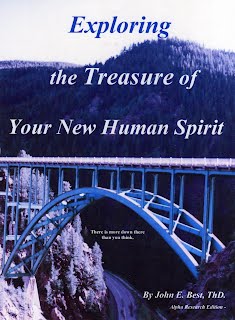
New book by Dr. John Best

From the author:

This new book is the result of almost two decades of teaching and several years of research, writing and editing. It is my longest, most in depth and documented book.

Most believers have overlooked or underestimated the value of their treasure–a human spirit that has been made alive and joined to Christ’s life!

I have researched  and written this guidebook to unpack for you the treasure chest of your regenerated human spirit. “Therefore, if anyone is in Christ, he is a new creation; old things have passed away; behold, all things have become new” (2 Corinthians 5:17, NKJV).

Have you ever wondered precisely how the old things have passed way when you still have a mortal body and are steps behind where you’d like to be in your thoughts, feelings, and actions? And what are the things that have become new in your life?

Answers to this, and many other relevant questions, await you in this unique book.

http://www.abundantlivingresources.org/books/exploring-the-treasure-of-your-new-human-spirit

Dr. R. Seymour: Systematic Theology

By Richard Seymour, D. D.

3. The Major Divisions of Man’s Being.

a. The question – Does man’s being consist of two or three divisions?

(1) Is he “dichotomous”?

(2) Is he “trichotomous”?

b. There are many passages in the Bible where the terms, “souls” and “spirit” are practically synonymous, designating simply the immaterial part of man. (cf. Jn.11:33 and 13:21 with Matt. 26:38)

(1) Those departed from this life are sometimes called “souls” (Rev. 6:9)

(2) Sometimes called “spirits”. (Heb. 12:23)

c. There are some passages where the Bible presents man as a dichotomous
being. These expressions simply mean the “material and immaterial part
of man”.

(1) Body and soul. (Matt.10:28)

(2) Body and spirit. (James 2:26)

d. There are other passages that make a clear distinction between soul and
spirit, indicating that they are not the same. (1 Thess. 5:23; Heb. 4:12)

(1) This is further illustrated in the Life of Christ, where we note in the
Gospels that He had a body (Jn. 19:38-40), a soul (Jn. 12:27) and a spirit (Jn. 13:21).

e. The soul is the immaterial part of man which reacts to self, and to the
environment of natural life.

f. The spirit is the immaterial part of man which enters into relationship with God. The spirit of an unsaved man is dead.

g. The body is the house in which we live.

h. The most accurate statement is that man is a soul and spirit, and possesses a body, in which he may be “at home: or from which he may be “absent”. (2 Cor. 5:1-8)

– R. Seymour, Systematic Theology, p. 46

Spirit, Soul, and Body

“Now may the God of peace Himself sanctify you completely; and may your whole spirit, soul, and body be preserved blameless at the coming of our Lord Jesus Christ. 24 He who calls you is faithful, who also will do it” (1 Thess. 5:23  NKJV).

“Spirit (Gk. pneuma) Luke 8:55; 1 Cor. 5:5, soul (Gk. psuche) Eph. 6:6; Phil. 1:27, body (soma), Matt. 6:22…The spirit enables a person to contact the divine Spirit
and is that part of a person that the Spirit quickens at the time of regeneration  (John 3:3; Rom. 8:16). The Greek word psuche, translated soul, means “life.” The New Testament writers use this word to speak of a person’s personality or inward, animating essence. Finally the New Testament writers identify the body, a person’s physical being, as separate from one’s soul or spirit. As this verse indicates, God works from the inside out, sanctifying our entire being…”
The Nelson Study Bible, p. 2029

Web site moves to WordPress.com

When my book was published– Man as Spirit, Soul, and Body: A Study of Biblical Psychology–I included a reference to the companion web site http://www.BiblicalPsychology.net. I have been wanting to add supplements to the site and have opted for the blog format of WordPress.com. The basic information is still available on the pages identified in the header. The blog section will feature posts that add evidence, examples, and discussion on the design of humankind as revealed in the Bible.